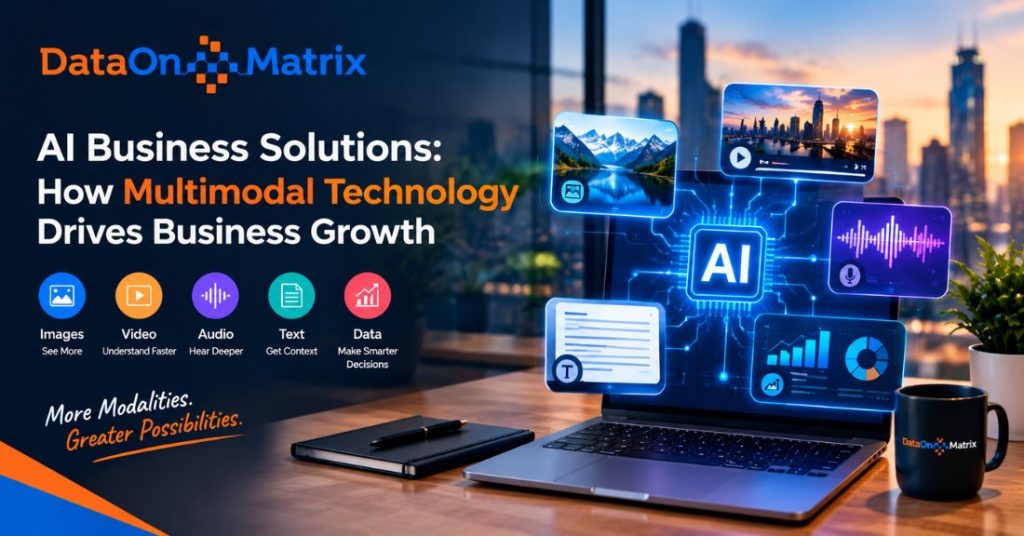
Businesses create and collect many types of information. They use text, images, audio, video, and data. Traditional AI often handles one type at a time. Multimodal technology changes the approach to AI business solutions.
This approach helps AI understand different data types together. This creates smarter and more useful business tools. Multimodal technology allows AI to process many data types.
These data types can include:
- Text
- Images
- Audio
- Video
- Documents
- Charts
- Tables
- Sensor data
- Digital records
Think about a customer support conversation.
Customers send a written message. They may also attach a photo. These customers could share a voice recording too. A multimodal system can study all these inputs together.
This gives the system more complete context.
A simple text system may miss important visual details. An image system may miss the customer’s written explanation. A multimodal system can connect both pieces.
This makes AI more aware of the full situation.
The technology works through different AI models. These models process specific forms of information. Another layer then connects their outputs.
The system can understand relationships between inputs. It can also produce useful responses from that information.
This is important for modern businesses.
Businesses rarely work with one data type alone. Their routine work normally includes different formats. Multimodal AI brings these formats into one workflow.
Why Businesses Need Multimodal AI
Business information is becoming more complex. A single customer may create several data points. These points can come from different channels.
For example, a customer may:
- Send an email.
- Upload a product photo.
- Call the support team.
- Share a screen recording.
- Complete a website form.
Each action contains useful information.
Old systems often treat these actions separately. Employees then need to connect everything manually. That process takes time. It can also create mistakes.
Multimodal AI can connect these inputs. It can create a clearer picture of each case. This can improve many business processes.
Customer service is one major example.
An AI system reads the message of a customer. It inspects an attached image. The system understands a voice note. It can then suggest a suitable response.
The employee gets more context. The customer also gets faster help.
This approach can support better service without making workflows harder.
1. Making Customer Support More Intelligent
Customer support creates huge amounts of information.
Support teams receive emails every day. They also receive chats and phone calls. Customers may send screenshots as well. Each item may explain part of a problem.
Multimodal AI can bring these details together.
Imagine a customer reports a software problem. They explain the issue through chat. Then they upload a screenshot.
The AI reads the message first. It then studies the screenshot. The system can compare both pieces. It may identify the error shown on the screen.
This gives support workers useful background.
AI can also prepare response suggestions. Human workers can review those suggestions before sending them.
This creates a useful balance. AI handles repetitive analysis. People handle judgment and communication. This approach can improve response speed.
2. Improving Business Data Analysis
Businesses already have large data collections. Companies use;
- Invoices
- Reports
- Charts
- Images
- Recordings
They may also store spreadsheets and scanned documents.
Multimodal AI can connect these sources. AI can examine these sources together. It may find patterns that are difficult to spot manually.
3. Better Document Understanding
Businesses work with documents every day. These documents can contain many formats.
They often contain;
- Written paragraphs
- Tables
- Charts
- Signatures
- Images
Traditional document tools can struggle with this mix.
Multimodal AI can understand more than plain words. It can examine the structure of a document. The system can connect text with visual information.
This can help with many tasks.
For example, an insurance company may receive claim documents. A claim could contain written details and accident photos.
AI can review both sources. It can identify important information and highlight missing details. An employee can then review the case.
This can reduce manual document checking.
4. Connecting AI With Existing Business Systems
Many companies already use business software.
They may use;
- CRM systems
- ERP platforms
- Websites
- Internal tools
They may also have custom databases. Replacing everything is rarely practical.
A better approach can involve connecting AI with existing systems.
This is where AI development services in USA can support business needs. Teams can design AI systems around existing workflows. They can also connect different business data sources.
This reduces the need for employees to switch between tools.
AI can collect information from approved systems. It can then return useful results inside existing workflows.
This creates a smoother user experience.
Building AI Applications Around Real Business Needs
Every company has different goals.
- A retail business has different needs from a bank.
- A manufacturer also works differently from a healthcare provider.
This means AI should not always follow one standard design.
Custom AI software development services in USA help businesses create systems based on their unique needs.
A custom solution can use company data. It can follow existing approval steps and support specific user roles.
For example;
- A manager may need business summaries.
- An employee may need task recommendations.
Both users collaborate with the same system. But, they can receive different information.
This makes AI more practical. It also helps businesses avoid unnecessary features.
The Role of Multimodal AI in Web Applications
Web applications are central to many businesses.
- Customers use them for shopping and support.
- Employees use them for internal work.
Multimodal AI can make these applications more interactive.
A customer portal could accept written questions. It could also accept images or voice messages.
The system could process these inputs. It could then provide a suitable response.
A web app development company USA can help bring these capabilities into existing web platforms. The focus should remain on usability.
AI should make tasks easier. It should not make the interface confusing.
Clear responses can also build trust.
Better Automation Through Multimodal Understanding
Automation works best when systems understand context.
Simple automation follows fixed rules. Multimodal AI can understand richer information.
For example, a system could receive an invoice. It can read the written information. The system can also inspect tables.
A multimodal AI system may compare the invoice with purchase records. It could then flag differences. An employee can review the result.
This creates a human-controlled automation process.
Such workflows can save time. They can also reduce repetitive work.
Businesses can focus employees on higher-value tasks.
How Businesses Can Start with Multimodal AI
Businesses do not need to transform everything at once.
Starting small is often better.
- Identify one clear business problem.
- Choose a process that takes too much time.
- Identify the data used in that process.
- Ask whether the data includes multiple formats. A multimodal AI may be useful if it does.
- Next, define a measurable goal.
The goal could be faster response times. It could also involve fewer manual steps.
A pilot project can then test the idea. Teams should measure the results. They should also collect employee feedback.
Customer feedback can help too. It also creates a clearer path toward larger AI adoption.
Choosing the Right Technology Partner
Technology choices can affect project success. Businesses should look beyond impressive AI demonstrations.
A reliable partner should also understand data security. Experience with system integration is important. Strong testing practices also matter.
A capable software development company in New York may help organizations connect AI with existing software and workflows.
Businesses should also ask practical questions. Such as;
- How will the system handle sensitive data?
- How will users review AI outputs?
- How will performance be measured?
- How can the system grow later?
These questions help businesses choose wisely.
The goal should be long-term value. Not every business needs the most advanced model.
The Future of Multimodal Business AI
Multimodal AI will likely become more common.
Businesses are already moving toward richer digital experiences. Future systems may understand more forms of information.
They may process;
- Text
- Images
- Sound
- Video
This could create smarter digital assistants.
An employee could speak a request. The AI could review company documents. It could analyze a chart and prepare a useful response.
Customers may also interact with businesses more naturally.
They may;
- Speak
- Type
- Upload images
- Share videos
AI can understand these inputs as one conversation. This could make digital services feel more human. However, businesses should adopt these systems carefully.
Technology should solve real problems.
Dataonmatrix can be part of this broader technology journey. The important focus should remain on useful business outcomes. AI should help people work better, not simply add another technology layer.
Key Benefits of Multimodal AI
Multimodal technology can support businesses in many ways.
Some benefits include:
- Faster information processing.
- Better customer support.
- Easier document analysis.
- More useful business insights.
- Smarter workflow automation.
- Better employee productivity.
- More natural digital experiences.
- Improved knowledge access.
- Stronger decision support.
- Better use of business data.
These benefits depend on proper implementation.
Technology alone does not guarantee success. Businesses need responsible AI practices.
AI becomes more useful when these elements work together.
FAQs
1. What does multimodal AI mean?
Multimodal AI understands multiple data types together. These can include;
- Text
- Images
- Audio
- Video
2. How can multimodal AI help businesses?
Multimodal AI can improve support, automation, analysis, and productivity. It can connect information from different business sources.
3. Can multimodal AI work with existing software?
Yes, it can work with existing systems. APIs and integration layers can connect AI with business tools. Proper access controls should guide these connections.
4. Is multimodal AI useful for customer service?
Yes, customer service is a strong use case. AI can review messages, screenshots, and voice inputs. It can then help employees respond with better context.
5. Can small businesses use multimodal AI?
Yes, small businesses can use it too. A small pilot can help prove its value before expansion.
6. Is multimodal AI completely accurate?
No AI system is completely accurate. Multimodal models can still misunderstand information.
7. What data can multimodal systems process?
Multimodal systems can process
- Text
- Images
- Audio
- Video
- Other formats
They can also work with documents, charts, and tables.
8. What should businesses consider before adoption?
Businesses should consider security, cost, data quality, and accuracy. They should also define clear business goals.