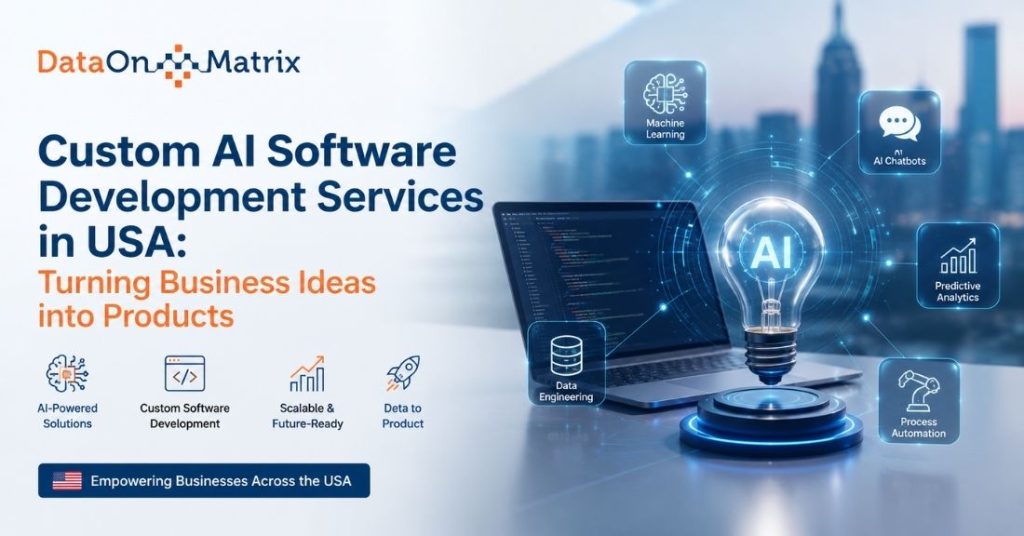
Turning a business idea into a real product can feel difficult. Custom AI software development services in USA can make this journey simpler. AI can help businesses build smarter and more useful products. It can also help teams understand customers better.
AI can turn simple ideas into practical digital experiences.
Today, many businesses have great ideas but struggle to build them. They may lack technical skills or the right development team. Custom AI development can bridge that gap. It combines business knowledge with modern technology. This helps companies create products that solve real customer problems.
AI is changing product development from smart web apps to intelligent business tools. Businesses now automate tasks and improve decisions. They can also create products that learn from user behavior. This creates more value for both companies and customers.
Why Business Ideas Need More Than Just Technology
A good idea is only the starting point. A successful product needs a clear purpose. It must also solve a real problem.
Imagine someone has an idea for a smart shopping app. The idea sounds simple. But many questions appear during development. Such as;
- How will users search for products?
- How will the app understand their needs?
- How will recommendations be created?
- How will customer data be handled?
- How will the product grow later?
These questions need careful planning. Technology alone cannot answer them.
A strong development process connects business goals with technical choices. Adding AI can then create real value. This approach avoids building features simply because they sound impressive.
The best products are often simple to use. Behind that simple experience, powerful technology may work quietly.
How AI Turns Ideas into Useful Products
AI can give digital products a smart layer. This layer helps software understand information and respond intelligently.
For example, an AI-powered product can:
- Understand customer questions.
- Recommend useful products.
- Predict customer needs.
- Automate repetitive work.
- Analyze large amounts of data.
- Detect unusual activity.
- Generate helpful content.
- Support employees with smart assistants.
These features improve the product experience. They can also save valuable time for businesses.
The important part is choosing the right AI feature. Not every product needs advanced AI everywhere. Sometimes, one smart feature can create more value than ten complex features.
Understanding Custom AI Product Development
Custom AI product development starts with the business idea. Developers first learn what the product should achieve. They then identify where AI can help.
This process usually includes several important stages.
1. Understanding the Business Idea
The first step is understanding the problem.
A development team studies the target audience. It also reviews business goals and product requirements.
This creates a clear product direction. It helps prevent unnecessary development work.
2. Planning the Product
The next step is product planning.
Teams decide which features should come first. They also define the minimum viable product.
This first version of the product should resolve the main issue. Extra features can come later.
A simple first release is often easier to test. It also gives businesses useful customer feedback.
3. Selecting the Right AI Technology
Different AI tasks need different technologies.
- A chatbot may need natural language processing.
- A recommendation engine often needs machine learning.
- Image-based products may need computer vision.
Developers choose technology based on the actual business need.
4. Designing the User Experience
Good technology needs good design.
Users should understand how the product works. They should not need technical knowledge.
Simple screens and clear buttons make products easier to use.
AI should also feel natural. Users should understand when AI is helping them.
5. Building the Product
Developers then build the product.
The work may include;
- Frontend development
- Backend development
- APIs
- Databases
- AI models
Cloud platforms can also support product hosting. Security features should be included from the beginning.
6. Testing the Product
Testing helps find problems before customers do.
Developers test the software across different situations. They also check AI responses and system performance.
AI products need extra testing. AI can sometimes produce incorrect or unexpected results.
Testing helps reduce these risks.
7. Launching and Improving
You should not consider the first launch as the final step.
Real users provide valuable feedback. Their behavior can show what works and what needs improvement.
Businesses can use this information to improve the product over time.
This creates a healthy product development cycle.
The Role of AI Development Services
Modern AI development services in USA can support businesses at different stages. These services may cover;
- AI strategy
- Product development
- Integration
- Testing
- Maintenance
A business does not always need to build an AI model from scratch. Existing AI models can sometimes solve the problem faster.
Developers connect these models with business systems. They can also customize the experience around specific user needs.
This approach reduces development time. It can also help businesses focus on their core product.
What Types of Products Can Businesses Build?
AI can support many types of digital products.
1. AI-Powered Web Applications
A web application can use AI to create smarter experiences.
For example;
- An education platform could suggest lessons.
- A finance application could identify unusual spending.
- A sales platform could rank potential leads.
The possibilities depend on the business problem.
A reliable web app development company USA can combine web technology with AI features. This can create applications that are both useful and easy to access.
2. AI Mobile Applications
Mobile apps can also become more intelligent.
AI can power;
- Virtual assistants
- Personalized recommendations
- Smart search
- Automated support
Mobile AI products can use information from user interactions. This can help create more relevant experiences.
3. AI Customer Support Platforms
Customer support is another strong use case.
AI assistants answer common questions quickly. They can also guide users toward useful resources.
Complex questions can be moved to human agents. This creates a balance between automation and human support.
4. AI Sales and Marketing Tools
AI helps sales teams find better opportunities. It can analyze customer activity and identify useful patterns.
Marketing teams can use AI for;
- Content ideas
- Customer segmentation
- Campaign analysis
5. AI Business Management Tools
Businesses can build internal tools with AI features.
For example, an internal application could summarize reports. It could search company documents or answer employee questions.
How a Software Development Partner Helps
Choosing the right development partner can affect the product’s success.
A reliable development partner should align with both technology and business objectives. It should ask questions before suggesting solutions.
A software development company in New York may help businesses build custom applications with modern technologies.
Businesses should also review;
- Experience
- Development methods
- Security practices
- Communication
A strong partner should explain technical topics clearly. This helps business owners make better decisions.
AI Technologies Used in Custom Product Development
Modern AI products can use several technologies.
1. Machine Learning
Machine learning helps software learn from data. It can support predictions and recommendations.
2. Natural Language Processing
Natural language processing helps software understand human language. It can support;
- Chatbots
- Search tools
- Document processing
- Virtual assistants
3. Generative AI
Generative AI can create text, images, code, and other content. Businesses can use it for;
- Content tools
- Assistants
- Research platforms
- Productivity applications
4. Computer Vision
Computer vision helps software understand images and videos. It can support;
- Quality inspection
- Document scanning
- Security
- Visual search
5. Retrieval-Augmented Generation
RAG connects AI models with trusted business information. This can help AI provide answers based on company documents and knowledge bases.
6. AI Automation
AI automation can connect intelligent features with business workflows. It can reduce repetitive manual work.
Benefits of Building Custom AI Products
Custom AI products can provide several business benefits.
- Better Customer Experiences: Customers want quick and helpful experiences. AI can personalize interactions and provide faster support.
- Faster Business Operations: AI automates repetitive tasks. This allows employees to spend more time on important work.
- Smarter Decisions: AI analyzes large amounts of information. It can reveal patterns that may be difficult to see manually.
- Product Differentiation: Unique AI features help products stand apart. Businesses can offer experiences that competitors may not provide.
- Better Scalability: AI handles many digital tasks automatically. This can support growth without increasing manual workload.
- Continuous Improvement: AI products improve through feedback and better data. This allows businesses to refine their products after launch.
Building AI Products with Dataonmatrix
Businesses need more than coding when creating AI products. They need;
- Product thinking
- Clear planning
- Reliable development
Dataonmatrix can support businesses looking to turn ideas into practical digital products. The focus should always remain on the business problem.
A successful AI product should not use AI simply for attention. Each AI feature should have a clear purpose.
Security and Responsible AI Matter
AI products often work with valuable business data. Security should therefore be considered from the start.
Developers should protect sensitive information during storage and transfer. Access controls should also limit who can view important data.
Businesses should understand how AI systems process information. They should also test systems for inaccurate or harmful outputs.
Human review can be important for sensitive decisions. Trust is one of the most valuable parts of any product development.
A Simple Roadmap from Idea to Product
The journey can be easier when broken into small steps.
Step 1: Define the problem
Clearly explain what the product should solve.
Step 2: Understand the users
Learn what customers need and expect.
Step 3: Create the product plan
Choose the most important features.
Step 4: Identify AI opportunities
Discover areas where AI can create real value.
Step 5: Build an MVP
Create a simple working version.
Step 6: Test with users
Collect feedback and study results.
Step 7: Improve the product
Fix problems and add useful features.
Step 8: Scale carefully
Expand the product as demand grows.
This approach keeps development focused. It also reduces the risk of wasting resources.
Why Custom AI Is Becoming Important for Businesses
Businesses today compete on experience and speed.
- Customers expect quick answers.
- Employees expect better tools.
- Business owners need useful insights.
Standard software cannot always meet these needs.
Custom AI products can be designed around specific business processes. They can fit existing workflows and solve unique problems.
This is where AI business solutions can create meaningful value. The goal is not to replace people, but to help people work better.
AI can handle repetitive tasks. Humans can focus on creativity, relationships, and important decisions.
FAQs
1. What are custom AI software development services?
These services involve building AI-powered software for specific business needs. The product is designed around the company’s goals, users, and workflows.
2. Can a small business build an AI-powered product?
Yes, small businesses can build AI products. Starting with a focused MVP can control costs and reduce development risks.
3. How long will a simple AI product development take?
The timeline depends on product complexity. A simple AI feature may take less time than a complete AI platform.
4. Does every business need custom AI?
No. AI should be used when it solves a real problem. Some businesses may only need basic automation or traditional software.
5. Can AI connect with existing business software?
Yes, AI can often connect with existing systems. APIs and integrations can help connect AI with business applications.
6. Is custom AI software expensive?
Costs vary based on features, technology, integrations, and development time. A small MVP can help businesses test an idea before making a larger investment.
7. How can businesses keep AI products secure?
Businesses should use strong access controls and secure data practices. Regular testing and monitoring can also improve product security.
8. Why should businesses start with an MVP?
An MVP helps test the main idea with real users. It can reveal problems early and guide future development decisions.