Building an AI product sounds exciting. The real work starts long before the first line of code. A business needs to define the problem, understand its users, prepare the data, and decide how the product will fit into existing systems. AI product development services can help businesses turn an idea into a useful product. AI product development services help businesses design, build, integrate, test, and improve AI-powered products that solve specific business or customer problems. An AI product should solve a real business problem. It should also be easy to use, reliable, secure, and affordable to maintain. A strong idea alone is not enough. The product needs a clear purpose and a practical plan.
What Is the AI Product Development Process?
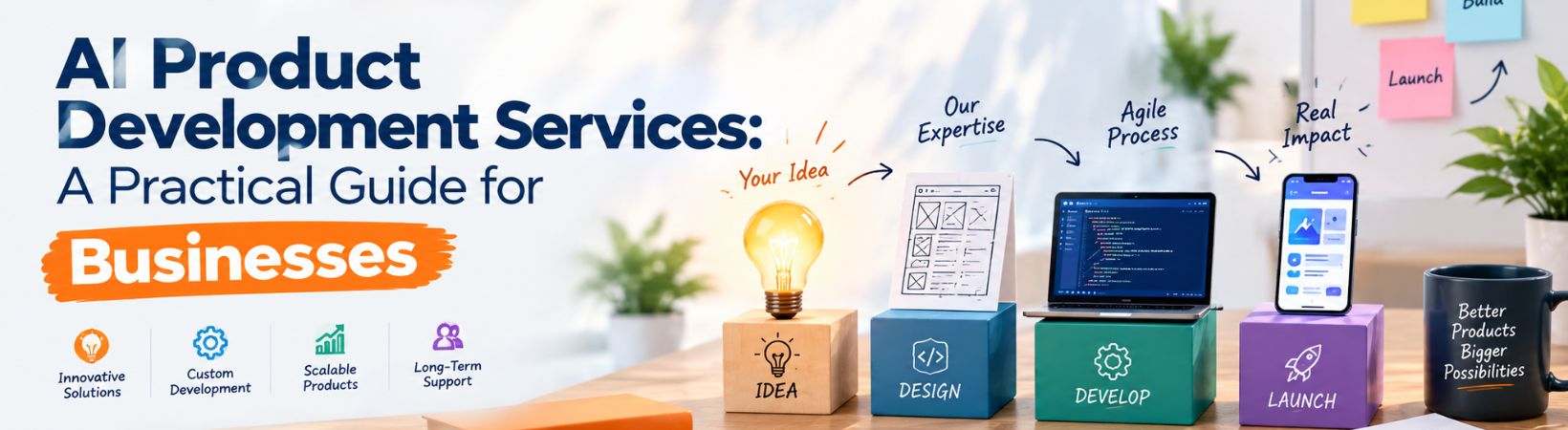
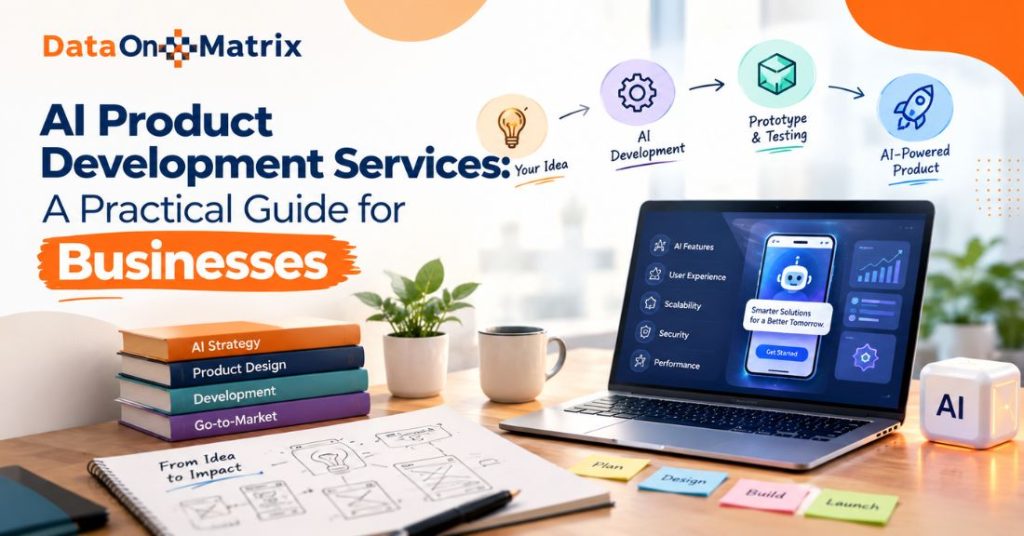
Developing an AI product involves more than adding an intelligent feature to an application. The right approach depends on the organization’s needs, users, data, and business goals. Depending on the product, teams may use machine learning, natural language processing, image recognition, predictive analytics, recommendation engines, or generative AI. The process typically starts by identifying the problem the product needs to solve and then selecting the appropriate AI approach.
- Business and product research
- AI feasibility assessment
- AI model selection or development
- Product and user interface design
- Software development
- AI integration
- Testing and quality checks
- Deployment
- Monitoring and ongoing improvements
What Makes an AI Product Worth Building?
An AI product is worth building when it solves a clear business problem, improves an existing workflow, or creates measurable value for customers or employees.
Just adding AI for everyone to talk about isn’t usually an excellent investment decision. A better question would be whether artificial intelligence makes an existing workflow simpler to manage, quicker, or more efficient.
For example:
- A logistics business could use AI to spot possible delivery delays.
- An online shop could show customers products that match their interests.
- A financial firm could use AI to flag transactions.
- A healthcare organization could reduce the time staff spend.
- A customer support team could use an AI assistant to answer common questions.
- A software company could add an AI feature that helps users.
What Should Businesses Define Before Building an AI Product?
Businesses need to have a few important things figured out. This includes the problem they want to solve, who will use the product, what results they expect, what data is available, how much they can spend, and how they will measure success. Clearing these points early can prevent unnecessary work and help the development team choose the right approach.
A simple checklist can include:
1. Define the Business Problem
Start with the problem. Define what the chatbot needs to accomplish. For example:
We want to reduce the number of basic customer support tickets handled manually.
2. Identify the Target Users
An AI tool made for employees may need a very different setup from one designed for customers.
Think about questions such as:
- Who are the main users?
- What problems do they face in their daily work?
- How often will they use the product?
- Will they access it from a phone, laptop, tablet, or other device?
- How comfortable are they with technology?
- What would make them feel confident using the product?
3. Set Measurable Goals
A product needs clear success measures. Measurable goals make it easier to decide whether the product is actually working.
For example, a company may aim to:
- Reduce support response time by 40%.
- Increase product recommendations that lead to purchases.
- Reduce manual data entry.
- Improve forecasting accuracy.
- Reduce the time employees spend searching for information.
Which AI Approach Makes the Most Sense for Your Product?
No single AI setup works for every business. The right choice depends on what the product needs to do, what data the company has, how accurate the results need to be, and how much time and money the company can invest. Choosing the most advanced model is not always the smartest move.
Here are three common routes businesses can consider:
1. Start With an Existing AI Model
Sometimes, you don’t need to build an AI system from scratch. If a product needs features such as writing text, summarizing documents, translating content, sorting information, or understanding images, an existing model or AI API may already do the job.
2. Adapt AI to Your Business Needs
An off-the-shelf model may work well but still needs some adjustment. A business might want the AI to work with its own documents, follow specific instructions, or respond in a particular way.
3. Build a Custom AI System
A company with highly specialized data, unusual requirements, or strict accuracy targets may benefit from custom AI development services. The key is to avoid overcomplicating the solution. There may be little reason to spend extra time and money building something from scratch.
How Can Generative AI Improve an AI Product?
Generative AI can add capabilities such as content generation, document summarization, conversational interfaces, and intelligent responses to an AI product. Generative AI development services can help businesses add these capabilities to customer-facing and internal products.
For example, a company could build a platform that allows employees to ask questions about internal documents. A marketing tool could create first drafts of product descriptions. A customer service platform could suggest responses for support agents. AI-generated answers can sometimes be incorrect, incomplete, or outdated. It needs proper instructions, data access, safeguards, testing, monitoring, and human oversight where required.
Businesses should decide in advance:
- What information can the AI access?
- What information should remain private?
- When should a human review an answer?
- What happens when the AI is uncertain?
- How will incorrect responses be reported?
- How will the system be monitored?
Getting Your Data Ready for an AI Product:
Data is often one of the biggest factors affecting AI product quality. A business should understand what data it has, where it comes from, how reliable it is, and whether it can be used legally.
Data may include:
- Customer records
- Product information
- Images
- Documents
- Transaction history
- Support conversations
- Sensor information
- Website activity
- Internal company knowledge
How Much Does It Cost to Build an AI Product?
The cost of building an AI product varies based on its complexity, AI model, data requirements, integrations, security needs, user interface, and ongoing maintenance.
A basic AI feature may cost much less than a complete AI-powered platform.
Major cost factors include:
| Cost | Why It Matters? |
| Maintenance | Models and software need monitoring and updates |
| Cloud usage | AI workloads can create ongoing infrastructure costs |
| Security | Sensitive applications may require additional controls |
| User interface | A complex product needs more design and testing |
| Integrations | Connecting existing systems adds development work |
| Data preparation | Cleaning and organizing data can take significant time |
| AI model | Different models have different costs |
| Product complexity | More features require more development |
Should You Build or Buy an AI Solution?
Businesses should build a smart solution when they need unique capabilities or want AI to become a core part of their product. Buying an existing solution can make more sense when the need is common and a reliable product already exists. A simple comparison can help:
When Should You Build It?
- The problem is highly specific.
- AI is central to the product.
- The business has unique data.
- Existing tools cannot meet key requirements.
- The company needs greater control.
Buy it when:
- The requirement is common.
- A proven solution already exists.
- Speed is more important than customization.
- Building internally would cost too much.
How Should Businesses Test an AI Product?
AI products should be tested at both the software and AI levels to ensure they work correctly, produce useful results, protect data, and provide a good user experience.
A product can work perfectly from a technical perspective and still produce poor AI results.
Testing should cover:
1. Functional Testing
Does the application perform its basic functions correctly?
2. AI Performance Testing
Does the model produce useful and accurate results?
3. Security Testing
Can unauthorized users access private data or manipulate the system?
4. User Testing
Can real users understand and use the product without confusion?
5. Edge-Case Testing
What happens when the system receives unusual, incomplete, or unexpected input?
What Common Mistakes Should Businesses Avoid?
Many AI projects struggle because the business problem was not clearly defined before development. Others become too large, too expensive, or too complicated before the team proves the basic idea works. Common mistakes include:
- Starting with technology instead of a business problem
- Trying to build too many features at once
- Ignoring data quality
- Underestimating ongoing AI costs
- Skipping user testing
- Treating security as an afterthought
- Expecting perfect AI results
- Launching without a monitoring plan
What Does a Practical AI Product Roadmap Look Like?
A practical roadmap usually moves from a small idea to a tested product instead of trying to build everything at once.
1. Validate the Idea
Confirm that the problem is real and worth solving.
2. Check AI Feasibility
Review the data, technology options, risks, and expected results.
3. Define the MVP
Choose the smallest useful version of the product.
4. Build and Test
Develop the core product and test it with realistic data and users.
5. Measure Results
Compare the product against the original business goals.
6. Improve
Fix weak areas and add features based on actual user needs.
7. Scale Carefully
Increase users, data, integrations, and features only when the product is ready.
Conclusion: Build the Product Around the Problem
AI product development is not simply about choosing a model and adding it to an application. The strongest products begin with a clear business problem, a defined user need, reliable data, realistic goals, and a plan for testing and improvement. Businesses should also avoid making the first version unnecessarily large. A focused product can provide useful evidence about customer demand, AI performance, operating costs, and future requirements.
Common Questions About Building an AI Product
1. How much time does it take to build an AI product?
It depends on what you are building. A simple AI feature may be ready in a few weeks, while a larger system with custom features, data work, and several integrations can take months.
2. Is it better to build custom AI or use an existing model?
Not necessarily. Custom AI development services make sense when a business has specific needs that existing models cannot handle well. If an available model already does the job, using it can save both time and money.
3. Can a small business build its own AI solution?
Yes. A small business can start with one useful feature instead of trying to build a large system from day one. Testing a smaller version with real users can show what works before more money is invested.
4. What can generative AI development services help with?
Generative AI development services can be used to create tools that write or work with text, images, code, summaries, and reports. They can also support chat assistants, document search, content tools, and other business applications.
5. Does an AI product need a lot of data?
Not always, but the quality of the available data matters. Before development, businesses should check whether their data is accurate, relevant, up to date, and safe to use. Privacy and access rules also need to be clear.
6. How do I choose an AI development partner?
Start by looking at the team’s past work and experience with projects similar to yours. Good communication, clear pricing, testing practices, security, and support after launch also matter. When comparing AI development services in the USA, do not choose a provider based on location alone. Look at what they have actually built and how they plan to support your product.
7. Does an AI product always need human review?
Not every AI tool needs the same level of human involvement. But review is important when an AI-generated result could affect someone’s money, health, legal situation, or customer experience. The right level of oversight depends on what the system does and how serious a wrong answer could be.