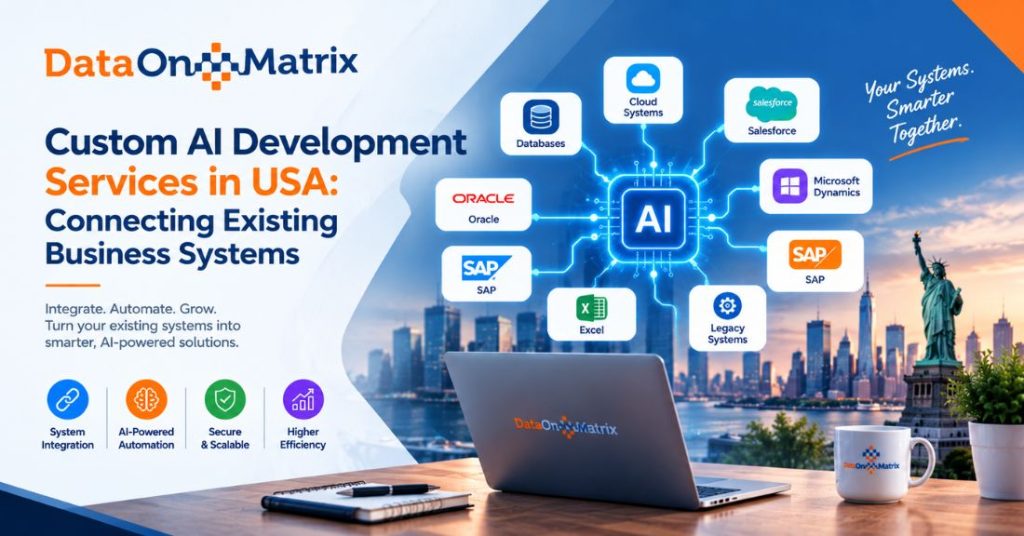
Modern businesses use many systems every day. These systems handle different business tasks. Some manage customers and sales. Others manage finance, staff, orders, or stock. Over time, these systems can become difficult to connect. Custom AI development services in USA can help businesses bring these systems together.
AI can work with existing tools without replacing everything. This approach can make business work faster and simpler. Many companies already have useful software. They may use CRM, ERP, HR, or accounting systems. Yet, the information may stay inside separate systems.
This creates a common business problem. AI can help solve these problems. The goal is not always to build new software. A better goal can be connecting what already works. AI can sit between existing systems. It can help them share information and perform useful tasks.
Why Businesses Need Connected Systems
A business system is useful on its own. However, its value can grow after integration. Connected systems can share data more easily.
Imagine a company receiving a new customer order.
The sales system records the customer details. The inventory system checks available products. The finance system creates billing information. The shipping system prepares delivery details.
The information can move automatically if these systems are connected. Most employees often manage these steps manually without integration. This takes more time. It can also create mistakes.
AI adds another useful layer.
Understanding AI Integration with Existing Systems
AI integration means connecting AI with current business software. The intelligent AI systems gather selected information using these tools. It can then process that information.
The result can be returned to the original system.
For example, an AI assistant can read customer questions. It can check order details from an ERP. The assistant can then provide a suitable answer.
Integration can happen through;
- APIs, databases
- Webhooks
- Middleware
The right method depends on the business setup. A careful integration plan is important.
Businesses should first understand their current systems. They should identify which tools need connection. This prevents unnecessary system changes.
1. Connecting CRM Systems with AI
CRM systems contain valuable customer information. They can store;
- Names
- Contacts
- Sales history
- Support records
They may also contain customer preferences. AI can use this information in useful ways.
AI can summarize long customer conversations. It can highlight important requests. AI can also suggest suitable follow-up actions.
Sales teams can then spend more time with customers.
Customer support teams can also benefit.
An AI assistant can check previous tickets. It can look at customer history. The assistant can then provide a helpful response.
This creates a useful balance between speed and human control.
2. Connecting ERP Systems with AI
ERP platforms often manage important business operations. They may handle;
- Purchasing
- Inventory
- Finance
- Production
These systems contain large amounts of structured data. AI can help employees understand this data.
For example, a manager may ask:
“Which products are running low?”
The AI system can check inventory records. It can then provide a simple answer.
This makes complex information easier to understand.
AI can also support automated workflows. A low inventory level can trigger an alert. A new purchase request can start an approval process.
These actions can reduce manual work.
3. AI and Legacy Business Systems
Many businesses still use older software. These systems may be reliable. Replacing them can also be expensive.
This creates a difficult choice.
Companies may want AI. But they may not want to replace existing software.
Integration provides another option. AI can connect with legacy systems through available interfaces. Middleware can act as a bridge in some cases.
This allows gradual modernization.
Businesses can improve their technology without making one huge change. A careful approach is important here.
Older systems may have limited APIs. Their data may also use older formats. Security controls may also need special attention.
Technical teams should study these issues first.
4. Using AI to Connect Business Databases
Databases have become the groundwork of many business applications. They store;
- Customer
- Product
- Employee
- Transaction data
AI works with databases in several ways. It can retrieve approved information and summarize records. AI can find patterns across large datasets.
However, AI should not receive unlimited database access. Access should follow strict rules. Businesses should decide which tables AI can access. They should also define which actions AI can perform.
For example, AI may read sales data. It may not be allowed to delete records.
This creates a safer system.
Data permissions should also match employee roles. Sensitive information should receive stronger protection.
5. Supporting Workflow Automation
Business teams often repeat the same tasks. These tasks may seem small. Yet, they can consume many working hours.
AI can help automate suitable workflows.
For example, a company receives a support request.
The AI system can read the request. It can identify the topic. The system can find customer details. It can then route the request to the right team.
Another example involves invoices.
AI system reads invoice information. It can compare the details with approved records. The system can then send the invoice for review.
These processes can reduce manual effort. This is where AI automation services in USA can support connected business operations.
Automation should still include human checks where needed. Not every task should become fully automatic.
6. Generative AI for Business System Integration
Generative AI can add another useful layer. It can understand natural language and create useful responses.
Employees do not always want complex dashboards. Sometimes they want simple answers.
For example:
“Show me this month’s delayed orders.”
A connected AI system can understand this request. It can access approved order data. The system then summarizes the results.
Generative AI can also create reports. It can summarize meetings and prepare customer responses.
Generative AI development services can help businesses build these capabilities around their current technology.
AI should not be added simply because it is popular.
Building AI Applications Around Existing Software
Businesses may need custom interfaces for their teams. These interfaces can connect several systems together.
For example, a company may build an AI dashboard.
The dashboard could show sales data. It shows inventory levels and displays support trends. AI could summarize the information.
Managers could then understand business conditions faster.
Another application could help employees search company information. It could connect to:
- Approved documents
- Databases
- Internal systems
This is where AI application development services can become useful. The application should match real business needs. It should also fit existing workflows.
Simple design is often better. Employees should not need extensive training.
Creating Secure AI Integrations
Security should be considered from the beginning.
AI systems can work with valuable business data. This may include;
- Financial information
- Customer records
- Employee records
Businesses should control AI access carefully. Authentication is one important layer. Authorization is another.
The system should verify who is requesting information. It should also check what information that person can access.
Data encryption is important as well.
Businesses should also maintain audit logs. Logs can show who accessed information. They can also show which actions were performed.
These controls support responsible AI adoption.
Choosing the Right AI Development Partner
The right development partner can make integration easier. Businesses should look beyond AI skills alone.
A strong partner should understand software integration. It should understand APIs and databases. The partner should also understand security and business workflows.
Experience with enterprise systems is valuable.
A reliable AI development company USA should also explain technical choices clearly. Businesses should know what will be built.
Clear communication is important throughout the project. The partner should also provide realistic timelines. It should explain possible technical limitations.
The Role of AI Consulting
Some companies know they need AI. They may have many systems. Most of these systems have large amounts of data. Starting without a plan can create unnecessary costs.
An assessment can help.
Teams can review existing software. They can identify integration opportunities. It allows them to rank projects by value. This can create a practical AI roadmap.
AI consulting services in USA can help businesses make these early decisions. The goal should be a clear and realistic plan.
Businesses should know what to build first.
How Dataonmatrix Can Support Connected AI Solutions
Businesses often need practical solutions. They do not always need complete system replacement.
Dataonmatrix can support businesses that want to connect AI with existing technology. The focus can remain on;
- Integration
- Automation
- Data
- Useful business applications
A good implementation starts with understanding current systems.
The team reviews business workflows. It can identify useful integration points. This can also help define suitable AI functions. The solution can then grow over time.
This approach can help businesses control costs. It can also reduce disruption.
Common Business Systems That Can Work with AI
AI can connect with many types of business systems.
Common examples include:
- CRM platforms
- ERP platforms
- Accounting software
- HR systems
- Inventory systems
- E-commerce platforms
- Customer support tools
- Project management systems
- Document management tools
- Cloud databases
- Data warehouses
- Communication platforms
- Internal knowledge portals
Each system may need a different integration method. The right method depends on the technology. It also depends on the business goal.
Measuring the Success of AI Integration
AI projects should have clear success measures. Businesses should not only measure whether AI works. They should measure business impact.
Useful metrics may include:
- Reduced manual work
- Faster response times
- Lower processing costs
- Fewer data entry mistakes
- Faster report creation
- Better customer response times
- Higher employee productivity
- Improved data accuracy
- Faster decision-making
These measurements show whether the project provides real value. Businesses also collect employee feedback. Employees use these systems every day. Their feedback can reveal practical problems.
Continuous improvement can then make the system better.
FAQs
1. What does AI integration mean for a business?
AI integration means connecting AI with existing software. The AI can access approved business information. It can then support tasks and workflows.
2. Can AI work with old business software?
Yes, AI can work with many legacy systems. APIs and middleware can create useful connections. The available integration options depend on the old system.
3. Does AI integration require replacing current software?
No, replacement is not always necessary. AI can often work with existing tools. This can reduce disruption and project costs.
4. How can AI improve CRM operations?
AI systems summarize customer information. They can review customer conversations. These systems help teams find useful customer insights faster.
5. Is AI integration safe for business data?
It can be safe with proper controls. Businesses should use access permissions and encryption. Audit logs can also help monitor system activity.
6. How long will an AI integration project take?
The timeline depends on the project size. Simple integrations may take less time. Complex systems require more time for planning and testing.
7. What should businesses integrate first?
Businesses should start with a clear business problem. Repetitive and time-consuming workflows are often good choices. A small pilot can also reduce project risk.
8. How can businesses measure AI integration success?
Businesses can measure time savings and productivity. They can also track accuracy and response times. Cost savings and employee feedback can provide useful insights.