Every business works differently. For example, a retail company may struggle with stock planning. A logistics firm may spend hours tracking deliveries and handling delays. Off-the-shelf software can solve some of these problems. It may not cover every business need. This is where custom AI development services can help. A custom AI solution is built around a specific goal. It can help teams handle routine tasks, work with large amounts of data, and make better use of the information they already have. However, building smart software takes more than choosing a model and writing code. Businesses need to understand the problem, check their data, set clear goals, and decide how the solution will fit into daily operations. A practical approach helps companies invest in AI for the right reasons and avoid unnecessary development costs.
What Are Custom AI Development Services?
These services involve building or adapting artificial intelligence software to meet a company’s specific needs. These services can involve machine learning, predictive analysis, natural language processing, computer vision, and generative AI—depending on the business’s needs and the problems it wants to solve. While general-purpose software solutions are limited to the specific tasks they can perform, a custom AI solution can be developed to integrate with existing systems, internal data, and specific business processes. For instance, an e-retailer can estimate the likelihood that particular products will sell during a sale period. While a typical inventory tool can show current inventory, a personalized AI system can analyze past sales data, current demand, and seasonal trends to predict future stock levels.
The development process may cover:
- The analysis and requirements for the business.
- The process of preparing and reviewing data. The data preparation and review process.
- Selection or customization of AI models.
- The design and development of software.
- Seamless integration with other applications.
- Testing and performance testing checks.
- Planning and sustaining the deployment and maintenance.
Why Do Businesses Need AI Solutions Built Around Their Requirements?
Organizations require custom-made AI solutions when they cannot efficiently use existing AI tools and manual processes. A solution built from real business requirements that goes beyond adding functionality not required by the employees can solve these problems. Imagine a business that gets a hundred customer emails daily. The support team could be spending hours processing requests, identifying the urgent ones, and replying to the routine ones. An AI system could identify the classification of incoming messages and make suggestions to reply to them and forward complicated cases to the proper employee. This idea holds true for various businesses. Sometimes a manufacturer needs assistance in identifying defective products, or a financial services firm might be interested in identifying unusual transaction patterns.
Some indicators of when a company might need custom AI are:
- People do the same repetitive physical movements.
- Significant information is distributed in various systems.
- There is a specialized workflow that can’t be supported with existing software solutions.
- Teams are overwhelmed by the amount of data and have challenges making decisions from it.
- Delays or slow service happen regularly for customers.
A business requires a feature in the AI that is not available in the other products.
How Do Custom AI Development Services Work?
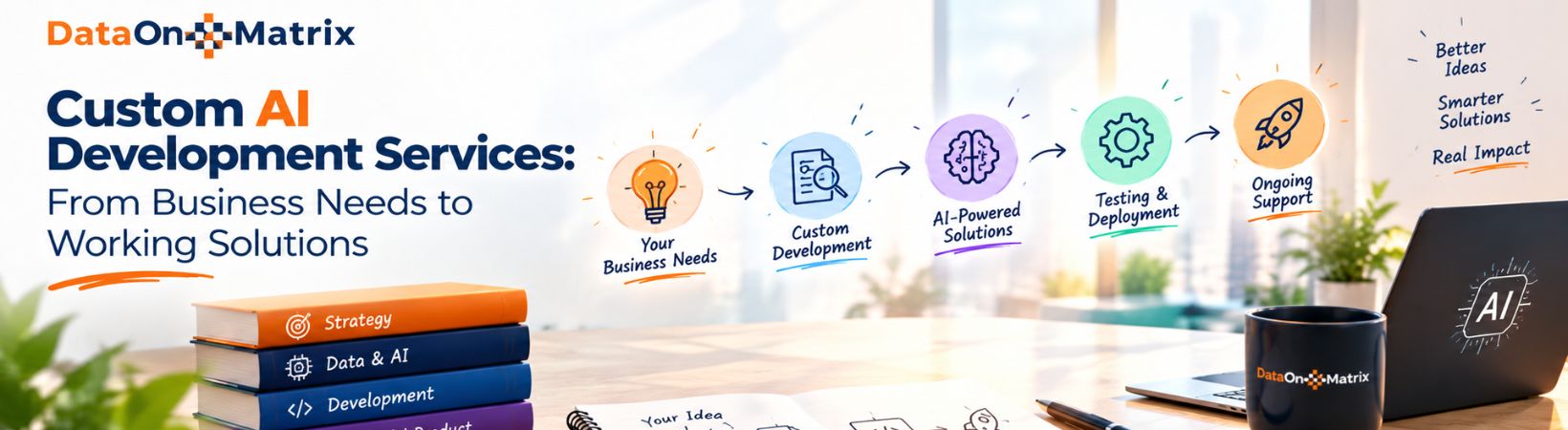
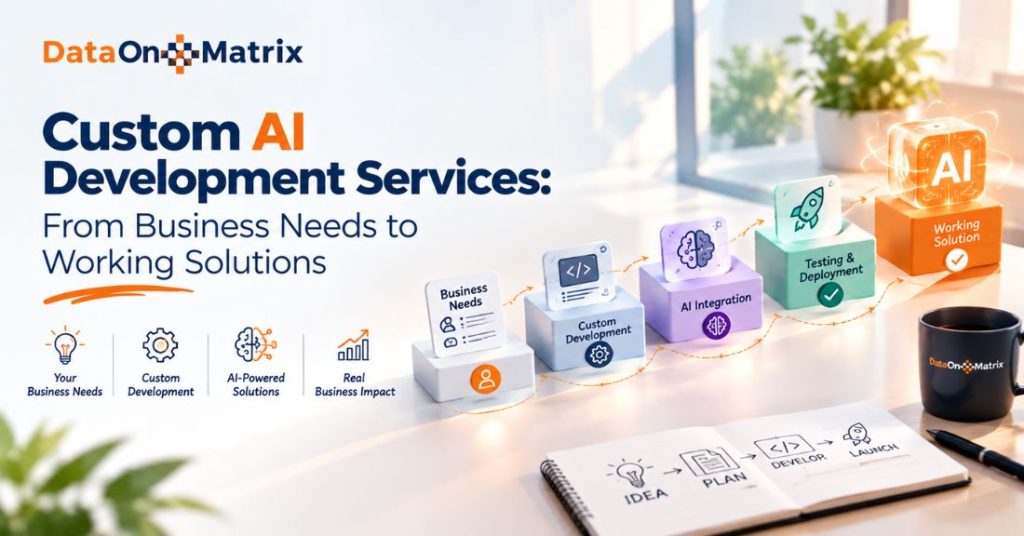
The process usually begins with a business problem. This moves through planning, development, testing, and deployment. Each stage helps the team check whether the proposed solution is useful, technically possible, and worth the investment.
1. Know What Needs to Be Improved:
The first step is to identify the area of the business that it wants to improve. It’s not enough to ask for AI for customer service; you need a clear concept of what you want to achieve with AI. A better objective would be to minimize the time spent by the employees sorting support tickets or to help customers themselves find answers to common questions. The business should also determine the criteria for success. These can range from response time, error rates, operating costs, customer satisfaction, or the number of tasks completed automatically.
2. Review the Available Data
AI systems are designed to make forecasts, identify patterns, or generate answers based on data. This review may find that there are missing records, duplicate records, out-of-date data, or privacy issues. If these issues are addressed early, it will help to avoid problems during testing. For instance, if the sales records are not complete, or if there is a stock-out that is not recorded, the demand forecasting system may give unreliable estimates.
3. Choose the Right AI Approach
The technology should be appropriate to the task. A machine learning model can be used to solve a forecasting task, a language model can be used to solve a document assistant task, and so on. There are three primary possibilities to consider:
- Use an existing AI model: Appropriate if there is an existing model that is already good at the task of interest.
- Modify an existing model: Useful for modifying properties, instructions, or behavior of a system that requires data, information, or behavior to be specific to a company.
- Develop an individual model: Useful if the problem is particularly one that involves specialized training, unique data, or performance that doesn’t match the capabilities of a pre-existing model.
4. Develop and Integrate the Solution
The most appropriate option will vary according to accuracy, cost, availability of data, security, and future maintenance requirements. After the approach is determined, the necessary software is developed and integrated with existing systems for use by employees. This can be customer relationship management (CRM) software, inventory software, databases, websites, or internal applications. Integration becomes a relevant factor as an AI tool that is not connected to regular work methods might not be easily embraced by employees.
5. Test Before Launch
Testing confirms the solution works under realistic conditions. The team should check the quality of AI outputs quality, software performance, and data protection. For generative AI applications, testing should also look for incorrect answers, exposure of sensitive information, and responses that fall outside the intended purpose.
What Are the Main Benefits of Custom AI Software?
Custom AI software can help businesses reduce repetitive work and support decisions that are difficult to handle manually. The actual benefit depends on the problem and how employees use the system.
1. Less Time Spent on Routine Work
AI can handle parts of repetitive processes, such as sorting documents, classifying support tickets, extracting information, or preparing initial reports. Employees can then spend more time on tasks that require judgment, communication, or specialist knowledge.
2. Better Use of Business Data
Many companies collect information but struggle to turn it into useful decisions. AI can help identify patterns that deserves attention. For example, a distributor may use historical sales and delivery records to identify products that are likely to face supply problems.
3. A More Helpful Customer Experience
AI-powered search, recommendation features, and support assistants can help customers find information without waiting for an employee to respond. Human staff can still handle complex questions, complaints, and situations that need personal attention.
4. Greater Flexibility
A tailored solution can be updated as the business grows. Businesses can add data sources, features, or workflows can they serve a clear purpose.
Where Can Businesses Use Custom AI Solutions?
Custom AI solutions can support many business functions. Here are some practical examples.
| Industry or Department | Possible AI Application | Business Benefit |
| Retail and e-commerce | Product recommendations and demand forecasting | Better shopping experiences and stock planning |
| Healthcare administration | Document sorting and appointment support | Less manual administrative work |
| Logistics | Delivery delay prediction and route analysis | Better planning and fewer avoidable delays |
| Manufacturing | Image-based defect detection | Faster quality checks |
| Finance | Unusual transaction detection | Earlier review of suspicious activity |
| Customer support | Ticket classification and response suggestions | Faster handling of routine requests |
| Human resources | Resume organization and document search | Less time spent on administrative tasks |
Example: AI for a Growing Online Store
Imagine an online store that sells hundreds of products. The team often runs out of popular items while holding excess stock of slow-moving products. A tailored forecasting system could examine previous sales, seasonal demand, promotions, and current inventory. It could then estimate which products may need replenishment. The system would not guarantee perfect forecasts. However, it could give the inventory team useful information earlier, helping employees make better purchasing decisions.
What Challenges Should Businesses Consider Before Investing in AI?
1. Data Quality
A business may not have enough reliable data for the planned application. Data might be incomplete, spread across disconnected systems, or collected in formats that are difficult to use.
2. Development and Operating Costs
The budget should cover more than the initial build. Businesses may also pay for cloud infrastructure, model usage, software integration, testing, monitoring, and ongoing support. A small pilot can help estimate these costs before a company commits to a larger project.
3. Privacy and Security
AI systems may process customer details, financial records, internal documents, or other sensitive information. Businesses should define who can access the data, where it is stored, and whether information is sent to external AI providers.
4. Accuracy and Human Review
AI can make mistakes, including producing confident but incorrect answers. The business should decide which outputs can be used automatically and which require employee approval.
5. Employee Adoption
Even a well-built tool can fail if employees find it confusing or do not trust its results. Involving future users during planning and testing can reveal practical problems early. Training and clear instructions can also help employees understand when to rely on AI and when to check its work.
How Do You Choose the Right AI Development Partner?
The right development partner should explain technical decisions. Expertise in the specific area and the nature of their process, not their promises. Here are some questions to ask when assessing a provider:
- Related experience: Does the team have experience in solving similar problems/industries?
- Business understanding: Can the team describe how the project is related to an objective?
- Technical approach: Will it be able to describe the reasons for the choice of a specific model or architecture?
- Data and security practices: What will be done with sensitive information?
- Integration skills: Will the solution integrate with existing systems?
- Testing process: How will it be done to test for accuracy, reliability, and outlier situations?
- Post-launch support: Who will be responsible for keeping track of the solution and resolving any problems?
- Show costs: Does the proposal provide information about development costs, usage costs, and maintenance costs?
When seeking out Custom AI Software Development Services in the USA, it is important to inquire about the communication process, project ownership, project milestones, and support. While location could be relevant to time zone or contract requirements, it shouldn’t make up for a comprehensive evaluation of technical skills and previous projects. Get people ready to tell you what they would do to solve your particular problem. A good team will be able to talk through the limitations, risks, alternatives and conditions that need to be met to achieve success. One of the solutions that businesses can consider for when they explore the field of AI development is DataOnMatrix. Like with all providers, it depends on the project needs, the provider’s experience, security measures and longterm support.
FAQs About Custom AI Development Services
1. What is the price of custom AI development services in the USA?
Costs will depend on the scope of the project, the requirements of the model, data preparation, integrations, security requirements and maintenance. Companies should ask for a comprehensive quote, which breaks down the costs of development and operating costs.
2. Do AI solutions have to be custom or not?
Not always. If the business is requiring something that already exists, it may be less expensive and quicker to implement. On the other hand, custom development is better when it comes to important workflows or technical requirements and existing options are not able to meet them.
3. Which sectors are the most likely to benefit from custom AI software?
AI can be applied to a variety of industries, including retail, healthcare administration, logistics, manufacturing, finance, and customer service. Some suitable uses for AI across different types of businesses include retail, healthcare administration, logistics, manufacturing, finance, and customer service. The results are dependent on the nature of the problem, the quality of the data, and the implementation of the solution.
4. What are some of the things that businesses should do first in the case of an AI project?
The problem needs to be clearly described, users need to be identified, existing data needs to be assessed, a budget needs to be established, and measurable success criteria need to be determined. They should also take into account privacy, security, integration requirements, and support requirements.
5. What are the differences between AI development and AI product development services?
AI development involves building or incorporating AI features and functionalities, such as predictive analytics, classification, or text generation. AI product development services encompass the broader spectrum of converting the capabilities into a product, ranging from planning and design to software development, testing, launch, and improvement.