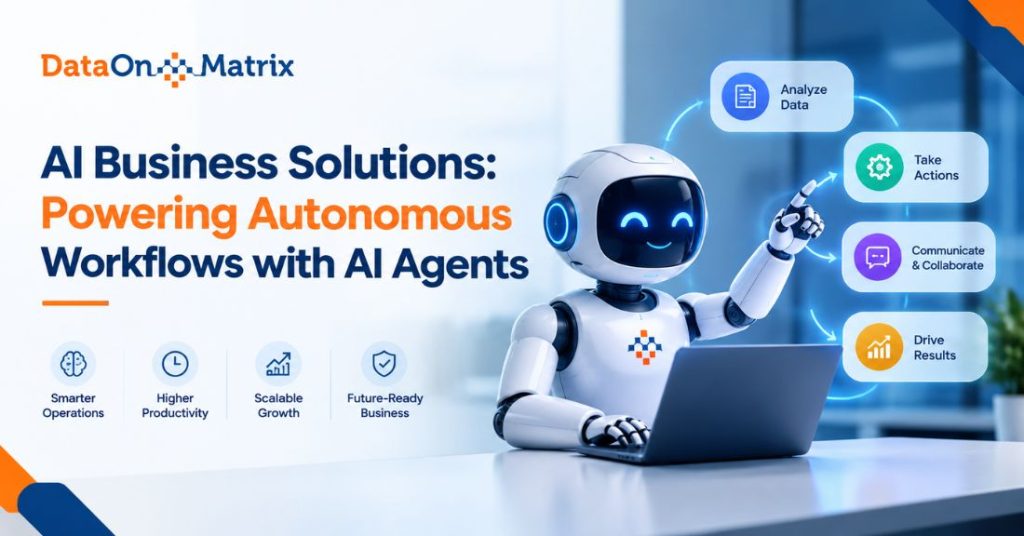
AI business solutions are AI-powered technologies that help businesses automate repetitive processes, improve decision-making, enhance customer experiences, and streamline everyday operations. AI agents make these solutions more powerful by understanding goals, accessing approved business tools, and completing multiple workflow steps with limited human intervention.
AI agents can now handle tasks with less human input. They can:
- Understand requests
- Find information
- Complete actions
This creates faster workflows and smoother business operations. It also helps teams spend more time on important work.
Imagine having a digital helper for your daily business tasks. It can read emails and sort customer requests. The digital helper can also update records and prepare simple reports.
Some agents even connect several tools. They can move information between systems without constant human effort.
This does not mean humans become unnecessary. Instead, people can focus on work needing creativity.
AI agents handle repetitive steps behind the scenes. This creates a helpful partnership between people and technology.
What Are AI Business Solutions?
AI business solutions use artificial intelligence to solve specific business problems, automate workflows, analyze information, and support better decisions. They typically combine software, business data, automation, and intelligent AI models to perform tasks that traditionally require manual effort.
Their purpose is simple. Traditional software usually follows fixed instructions. It waits for users to tell it what happens next. AI-powered software can understand situations and suggest actions.
For example, consider a customer support team.
A customer sends an email about a missing order. The AI agent reads the message first. It understands the customer’s main concern. Then it checks the order management system.
The agent finds the latest shipping information. It prepares a suitable response for the customer. A human employee can review that response. The employee can approve it with one click.
This simple workflow can save valuable time.
How Can AI Business Solutions Help Businesses?
AI business solutions can help businesses reduce repetitive work, improve operational efficiency, respond to customers faster, analyze business data, and support employees with intelligent automation. These technologies can be integrated into existing workflows to improve productivity while allowing employees to focus on higher-value tasks.
1. Automate Repetitive Processes
AI-powered systems can automate routine tasks such as data entry, document processing, appointment scheduling, report generation, and workflow management. This reduces the time employees spend on repetitive activities and helps teams complete routine processes more consistently.
2. Improve Customer Support
Intelligent tools can help businesses respond to customer questions, track requests, provide relevant information, and route complex issues to the right team. AI agents can also work with customer service systems to deliver faster and more personalized support.
3. Accelerate Sales Operations
AI can support sales teams by analyzing customer information, qualifying leads, automating follow-ups, and identifying potential opportunities. This allows sales professionals to spend less time on administrative work and more time engaging with prospects.
4. Analyze Business Data
Modern AI technologies can process large amounts of business data and identify useful patterns, trends, and insights. Companies can use these insights to understand customer behavior, monitor performance, and identify areas that need improvement.
5. Reduce Manual Work
Many workflows require employees to move information between different applications or repeat the same steps multiple times. Intelligent automation can connect approved business tools and handle parts of these processes, reducing manual effort and improving productivity.
6. Improve Decision-Making
AI can help decision-makers analyze relevant information and identify useful insights more quickly. Instead of relying entirely on manual analysis, businesses can use AI-supported insights to evaluate situations, identify opportunities, and respond to changing market conditions.
What Makes AI Agents Different?
AI agents are more than basic chatbots. A chatbot mainly provides answers to user questions. An agent can perform tasks after understanding a goal.
An AI agent may follow several steps.
- First, it receives a request.
- Next, it understands the user’s goal.
- Then, it gathers the needed information.
- After that, it selects an action.
- Finally, it completes the task or requests approval.
This makes agents useful for business workflows.
For example, a sales agent can receive a new lead. It can review the lead’s information. The agent can check previous customer interactions.
Then, it can prepare a personalized message. It can even schedule a follow-up. A sales employee can review everything beforehand.
The agent handles the busy work. The employee controls the final decision.
Why Businesses Are Moving Toward Autonomous Workflows
Many companies still depend on manual processes. Employees move data between different applications. They answer similar questions repeatedly.
They also create reports from several sources. These small tasks can consume many working hours.
Autonomous workflows reduce this burden.
An AI agent can connect different business systems. It can move through multiple workflow steps. The agent can also respond when certain events happen.
For example, imagine an online order workflow.
A customer places an order. The system checks payment details. Then, an agent reviews the inventory level.
The workflow continues automatically if stock exists. The warehouse system receives the order. The customer receives an order confirmation.
Another workflow can start if stock is unavailable. It might notify the purchasing team.
This creates a smoother process with fewer manual steps.
How AI Agents Power Autonomous Workflows
Autonomous workflows usually contain several connected components.
- The first component is the user interface. It receives instructions from employees or customers.
- The second component is the AI model. It understands language and context.
- The third component is the business logic. It controls what actions are allowed.
- The fourth component is the tool layer. It connects the agent with business software.
- The final component is the monitoring system. It tracks actions and workflow results.
These components work together.
Suppose an employee asks an agent to prepare a sales report. The agent understands the request. It then accesses approved sales data.
The agent collects the required numbers. It organizes those numbers into a report.
The agent can then send the report for review. This process can happen without many manual clicks.
Common Tasks AI Agents Can Handle
AI agents can support many everyday business activities. Their usefulness depends on available data and tools.
1. Customer Support
Agents can answer common customer questions. They can also check account information.
They may help with;
- Orders
- Returns
- Appointments
Complex issues can be moved to human employees. This creates faster customer support.
2. Sales Operations
Sales teams handle many repetitive activities. Agents can support lead qualification and follow-ups.
The agent can organize customer information. It can also prepare meeting summaries.
This gives salespeople more time for conversations.
3. Marketing Workflows
Marketing teams manage many small tasks. AI agents can help organize content workflows.
These agents can summarize campaign performance. They can also prepare basic content drafts.
Human marketers can review the final material.
4. Finance Operations
Finance teams process many documents and transactions. Agents can help organize financial information.
AI agents can identify missing information in documents. They can also prepare summaries for review.
Sensitive financial decisions should still receive human oversight.
5. Human Resources
HR teams receive many employee requests. Agents can answer common policy questions.
These agents can also help organize onboarding tasks. They may remind employees about required documents.
This can make HR workflows much easier.
The Role of AI Development Services
Businesses often need customized AI systems. Every company has different processes and data.
This is where AI development services in USA can support business transformation. Development teams build solutions around specific workflows.
Developers connect AI with existing business applications. They can also create custom interfaces for employees.
A good development process starts with the business problem. Technology comes after understanding that problem.
This approach helps avoid unnecessary complexity.
Building Custom AI Software for Business Needs
Off-the-shelf tools can be useful for simple tasks. Custom AI software development services in USA can create applications around unique requirements.
For example;
- A logistics company may need an intelligent dispatch system.
- A retailer may need an AI shopping assistant.
- A healthcare organization may need document processing.
- A bank may need intelligent customer support.
Each use case has different requirements.
Custom development can also support existing business systems. This reduces the need to replace everything.
Connecting AI Agents With Existing Software
An AI agent becomes more helpful when it accesses specific business tools.
A business may already use several applications. These might include;
- CRM platforms
- Accounting tools
- Helpdesk software
- Databases
AI can connect these systems through APIs and other integrations.
Consider a customer support workflow.
- The agent receives a customer question.
- It checks the CRM for customer details.
- Then, it checks the order system.
- It may also check the company’s support policies.
- Finally, it prepares an answer.
The employee sees the full response in one place. This saves time and reduces repeated searching.
The Importance of Web Applications
Many AI workflows need an easy user interface. Employees should not need technical skills.
A software development company in New York can build user-friendly business applications. These applications can place AI features inside familiar workflows.
For example, an employee might see an AI assistant inside a dashboard.
The dashboard could show:
- Customer information
- Recent conversations
- Suggested actions
- Workflow status
- AI-generated summaries
- Approval requests
Everything stays in one simple interface.
AI Agents Inside Modern Web Applications
A web app development company USA can combine AI agents with web applications. This creates intelligent tools accessible through standard browsers.
For example;
- An online business portal could include an AI assistant.
- Users could ask questions using normal language.
- The assistant could then perform approved actions.
A manager might say, “Show today’s pending orders.” The agent retrieves the information.
The manager could then ask, “Which orders need attention?” The agent analyzes the available data.
The manager might finally say, “Prepare messages for those customers.”
The agent creates the drafts. The manager reviews and approves them.
This creates a simple conversational workflow.
The AI Agent Development Process
Successful agent development needs a clear process.
Step 1: Find the Right Workflow
Start with one specific business process. Look for repetitive and time-consuming tasks. Avoid automating everything at once.
Step 2: Define the Agent’s Goal
Clearly explain what the agent should accomplish. Also define what it should never do. This creates clear boundaries.
Step 3: Connect Required Tools
Give the agent access to necessary systems. Avoid unnecessary permissions. Only connect tools required for the workflow.
Step 4: Build the Workflow
Developers create the agent logic and integrations. They also define approval steps.
Step 5: Test Real Scenarios
Testing should include normal and unusual cases. Teams should also test incorrect user requests.
Step 6: Launch Carefully
Start with a controlled rollout. Monitor performance and collect feedback.
Step 7: Improve Over Time
AI workflows should evolve with business needs. Teams can improve prompts, data, tools, and rules. Continuous improvement keeps systems useful.
Why Dataonmatrix Can Support AI Transformation
Businesses need practical solutions instead of adopting complicated technology. Dataonmatrix can help companies turn AI ideas into useful applications.
The right AI agent development starts with understanding the business needs. Developers then select suitable models and tools.
The solution should fit existing workflows and remain simple for employees.
What Businesses Need to Consider Before Using an AI Agent
AI agents can create strong value. However, businesses should plan carefully.
- Start with a clear problem.
- Then, check whether good data exists.
- Review security and privacy requirements.
- Define human approval points.
- Choose measurable success goals.
- Finally, test the workflow before expanding it.
This approach reduces unnecessary risks.
FAQs
1. What are AI agents?
An AI agent is the software system that can perform different tasks. They understand goals and follow defined workflows.
2. How do AI agents support businesses?
They can automate repetitive tasks and connect business systems. They can provide useful information to employees.
3. Are AI agents the same as chatbots?
No. Chatbots mainly focus on conversations. Agents can also perform actions and complete workflows.
4. Can AI agents work without humans?
Some tasks can run automatically. Sensitive actions should usually include human approval.
5. Are autonomous workflows secure?
They can be secure with proper controls. Businesses should limit permissions and monitor agent activity.
6. Can AI agents connect with existing applications?
Yes. APIs and integrations can connect agents with business systems. This allows agents to access approved tools.
7. Which businesses can use AI agents?
Almost any industry can explore suitable use cases. It includes;
- Retail
- Finance
- Logistics
- Healthcare
- Many others
8. How should a business start with AI agents?
Start with one clear and repetitive workflow. Measure results before expanding the system.