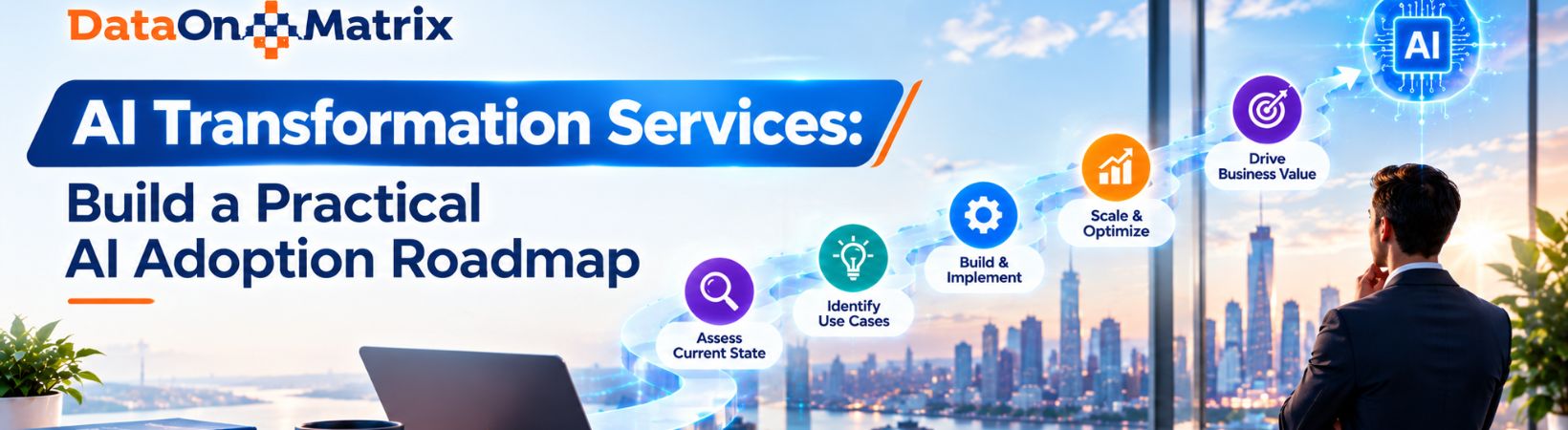
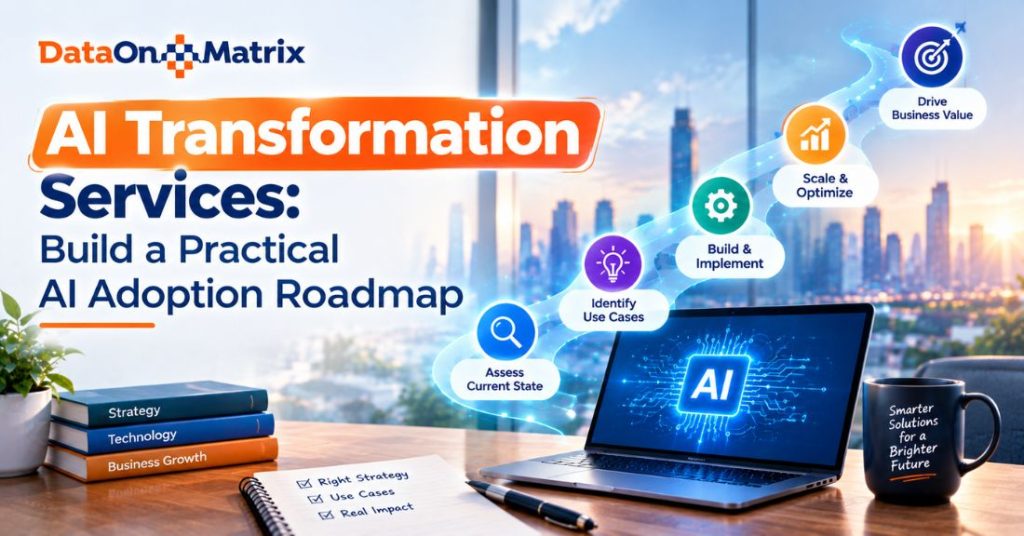
Artificial intelligence is no longer limited to large technology companies. Businesses of different sizes are now exploring AI for daily work. They use it to:
- Understand customers
- Automate tasks
- Analyze data
- Improve operations
There are many tools, platforms, and possible use cases.
Businesses can use AI transformation services to get clear direction. These services help businesses connect AI opportunities with actual business requirements. Companies can decide where AI can create useful results.
A practical AI roadmap does not need to cover everything at once. It can begin with one process, one team, or one business problem. The company can test the idea, measure the outcome, and expand when the results make sense.
This approach reduces unnecessary spending for:
- Business owners
- Decision-makers
- Technology leaders
It also makes AI adoption easier for employees and customers.
What Are AI Transformation Services?
AI transformation services help businesses introduce artificial intelligence into their existing operations and future plans.
The work may begin with understanding business processes.
It can then move toward:
- Strategy
- Data preparation
- Solution design
- Development
- Integration
- Deployment
- Ongoing improvement
The main purpose is to make AI useful within the business.
For example, a company may spend many hours reviewing customer requests. An AI system could sort those requests automatically. It could identify common questions and send complicated cases to employees.
A complete transformation program may include:
- AI readiness assessment
- Business process analysis
- AI strategy planning
- Use-case discovery
- Data assessment
- AI solution design
- Proof-of-concept development
- AI application development
- Business system integration
- Employee training
- Performance monitoring
- AI governance
Every company will need a different combination of these services.
A small company normally needs help with only one workflow. A large organization may need a company-wide AI strategy.
The right approach depends on business goals, resources, data, and technical maturity.
Why Do Businesses Need an AI Adoption Roadmap?
Many businesses want to use AI. However, wanting AI and implementing it successfully are different things.
A company may purchase several AI tools without having a clear plan. Employees may use different platforms for different tasks. Data may remain separated across departments. Some projects may never move beyond experimentation.
An adoption roadmap creates order.
It helps leaders answer important questions before spending heavily.
For example:
- Which business problems should AI address?
- Which processes should be automated first?
- Is the required data available?
- What will implementation cost?
- Who will manage the project?
- What risks should be considered?
- How will success be measured?
These questions make AI planning more practical.
A roadmap also prevents a common mistake. Businesses sometimes start with technology and search for a problem later.
A better approach works in reverse.
Find the problem first. Then select the technology.
How Businesses Create a Practical AI Roadmap
Building an AI roadmap does not require a complicated process. The important part is making each stage clear.
1. Define the business outcome
Start by identifying what the company wants to improve.
The goal could involve:
- Lower operating costs
- Faster customer responses
- Better sales conversion
- Fewer manual tasks
- Improved forecasting
- Faster reporting
- Better employee productivity
- More personalized customer experiences
A specific goal gives the project a useful direction.
2. Review existing processes
Next, examine how work currently happens.
Talk with employees who handle these processes every day. They often know where delays and repetitive tasks exist.
Look for activities that involve:
- Repeated data entry
- Manual document review
- Frequent customer questions
- Large amounts of text
- Repetitive reporting
- Data classification
- Pattern identification
- Routine decision support
These areas normally provide much better opportunities for AI. However, not every repetitive task needs AI.
Simple automation may be enough for some processes.
AI can become more helpful when the workflow involves:
- Language
- Prediction
- Classification
- Complex data
3. Check data readiness
AI depends heavily on data.
Before development begins, businesses should understand their available information.
Ask:
- Where is the data stored?
- Is it accurate?
- Is it complete?
- Who can access it?
- Does it contain sensitive information?
- Can different systems share it?
- Is historical information available?
For example, predictions may not be reliable if sales records are incomplete.
Data preparation may therefore become an important part of the roadmap.
4. Create an AI use-case list
Now create a list of possible AI opportunities.
Do not immediately approve every idea. Instead, describe each opportunity clearly.
For example:
- Problem: Employees spend hours answering basic policy questions.
- Possible solution: An internal AI knowledge assistant.
- Expected benefit: Faster answers and fewer repetitive HR requests.
- Main requirement: Reliable company documentation.
This simple format makes ideas easier to compare.
5. Prioritize the opportunities
Some AI projects may have high value. Others may require too much effort.
Businesses can compare projects using several factors.
| Factor | Question |
| Business value | Could this solve an important problem? |
| Cost | What resources are required? |
| Complexity | How difficult is implementation? |
| Data | Is suitable data available? |
| Risk | What could happen if the system makes mistakes? |
| Time | How quickly can the project deliver results? |
| Scalability | Could the solution support future growth? |
A project needs to make business sense.
How Do AI Transformation Services Support Implementation?
Once a business chooses its first use case, implementation can begin.
This is where a structured transformation process becomes valuable.
1. Start with a small pilot
A pilot gives the company a controlled testing environment.
Suppose a retailer wants to build an AI customer assistant.
Instead of launching it across every channel, the company could start with website support.
The team can then study:
- Answer quality
- Customer satisfaction
- Response speed
- Escalation rates
- Operating costs
The results provide evidence for the next decision.
2. Connect AI with existing systems
AI rarely works alone.
It may need information from:
- CRM platforms
- Databases
- Websites
- ERP systems
- Communication tools
- Internal applications
Proper integration allows the AI system to work within existing business processes.
For example, a sales assistant might need access to approved customer information. Employees will still need to copy information manually without integration.
That would reduce the value of the solution.
3. Prepare employees
Technology adoption is also a people issue.
Training can cover:
- Using the AI system
- Checking AI-generated information
- Protecting sensitive data
- Reporting errors
- Escalating unusual cases
Good training can make adoption smoother.
What Are the Main Benefits of AI Transformation?
AI transformation can affect different parts of an organization. The results depend on how well the selected use cases match actual business needs.
1. Higher employee productivity
AI can handle repetitive tasks. Employees can spend more time on work that requires judgment and creativity.
For example, an AI tool can summarize long documents. An employee can then review the summary instead of reading every page from scratch.
2. Faster customer service
Customers often want quick answers.
AI assistants can handle common questions at any time. They can also collect information before transferring complicated cases to support staff.
This can help reduce unnecessary waiting.
3. More useful business insights
Businesses generate large amounts of information. Finding important patterns manually can take time.
AI can help analyze information about:
- Sales
- Customer
- Operational
- Financial
For example, an AI system might identify changes in purchasing behavior. Managers can then investigate those changes and decide what action makes sense.
4. Reduced manual workload
Document processing is one practical example.
An AI system can extract information from:
- Invoices
- Forms
- Applications
- Contracts
Employees can then review exceptions instead of entering every field manually.
The savings can become meaningful when the process happens thousands of times.
Employees can focus on reviewing unusual cases instead of entering every piece of information themselves.
5. More personalized experiences
AI business solutions help businesses understand customer preferences.
Common examples include:
- Customer service assistants
- Product recommendations
- Automated email responses
- Voice assistants
- Personalized content
However, businesses should still provide human support when needed.
Financial companies may use customer information to personalize digital experiences.
Personalization should always respect applicable privacy requirements.
What Challenges Should Businesses Prepare For?
AI adoption can bring significant opportunities. It also comes with challenges.
1. Unclear expectations
AI is not a magic solution. Some problems are better solved with traditional software or process improvements.
Leaders should avoid promising results before testing the idea.
2. Poor-quality data
Unreliable data can affect AI performance. Data cleanup may be necessary before development.
Companies should clean and organize important data before building complex systems.
3. Security concerns
AI systems can handle sensitive business information.
Companies should consider access controls, data protection, security testing, and monitoring.
4. Employee concerns
Employees may worry about automation. Open communication can reduce confusion.
Companies should explain how AI will change workflows and provide suitable training.
5. Integration problems
New AI software needs to communicate with existing business systems.
Integration can become difficult when systems use different data formats or limited APIs.
This should be considered during early planning.
6. Ongoing maintenance
AI systems need monitoring. Business data can change. Customer behavior can change.
Models can also become less useful over time. Regular reviews help keep systems effective.
Where Do AI Consulting Services Fit into the Roadmap?
AI consulting services can help businesses make better decisions before investing heavily in technology.
AI consultants can help evaluate current processes. They also help teams compare different technical approaches.
Consultants may help answer questions such as:
- Should we build or buy?
- Which AI project should come first?
- What data will we need?
- What technology should we use?
- How much could implementation cost?
- What risks should we address?
- How should success be measured?
A consulting team can evaluate factors such as:
- Cost
- Data requirements
- Integration needs
- Security
- Scalability
- Maintenance
- Expected business value
This planning stage can prevent businesses from making expensive technology decisions too early.
What Should Businesses Consider Before Choosing a Provider?
Choosing AI development services in USA needs more than checking a service list. Businesses should examine the provider’s experience and working process.
1. Look for business understanding
A technical team should understand the business problem. Ask how the provider connects AI capabilities with measurable business goals.
2. Check technical experience
Review experience with relevant technologies and integrations. Depending on the project,
this may include:
- Machine learning
- Generative AI
- Natural language processing
- Computer vision
- Cloud platforms
- APIs
- Enterprise software integration
3. Ask about data security
Security should be discussed early. Ask how the provider handles sensitive information.
Also ask about access controls, data storage, and system monitoring.
4. Discuss scalability
A pilot is only the beginning.
Ask how the solution can grow as users, data, and workloads increase.
5. Understand ongoing costs
AI projects can have continuing expenses.
These may include:
- Cloud usage
- Model costs
- Maintenance
- Monitoring
- Support
A clear cost model helps businesses plan properly.
6. Ask about measurement
A provider should help define measurable success criteria. It becomes difficult to know whether the project created real value without metrics.
Businesses exploring these areas also evaluate providers, such as DataOnMatrix, as part of their wider technology research.
Conclusion:
AI adoption does not need to become a huge project from day one. Businesses can begin with one problem that matters.
They can:
- Study the process
- Check their data
- Select a suitable AI approach
- Run a controlled pilot
The results can then guide future investments.
A practical roadmap also keeps technology connected to business goals. It helps leaders avoid spending money on tools that do not solve meaningful problems.
Businesses should start small, measure results, learn from employees, and improve the solution over time. As successful projects become clear, they can gradually expand AI across other areas.
That is what makes AI adoption practical. It turns artificial intelligence from an exciting idea into a useful business capability.
FAQs
1. What are AI transformation services in the USA?
They help businesses plan, build, deploy, and improve AI solutions. Services can include strategy, consulting, development, integration, automation, and ongoing support.
2. How can a US company begin its AI adoption journey?
Start by identifying a real business problem. Then check data readiness, estimate potential value, select a manageable use case, and test it through a pilot.
3. Are AI transformation services only for large companies?
No. Smaller businesses can also adopt AI. They can start with a focused process instead of attempting a company-wide transformation.
4. When should a company use AI consulting services?
Companies can use consulting when they need help identifying use cases, evaluating technology options, creating an AI strategy, or planning implementation.
Consulting can be especially useful before making a large technology investment.
5. Does every company need custom AI development?
No. Some businesses can use existing AI products. Custom development makes more sense when specific business requirements cannot be met through available solutions.
6. What should companies consider before adopting AI?
Companies should review their goals, data, security requirements, budget, employee needs, existing technology, integration requirements, and expected business outcomes.
7. How can businesses measure AI adoption success?
Businesses can track metrics such as time saved, operating costs, error rates, customer satisfaction, employee adoption, processing speed, revenue impact, and productivity.