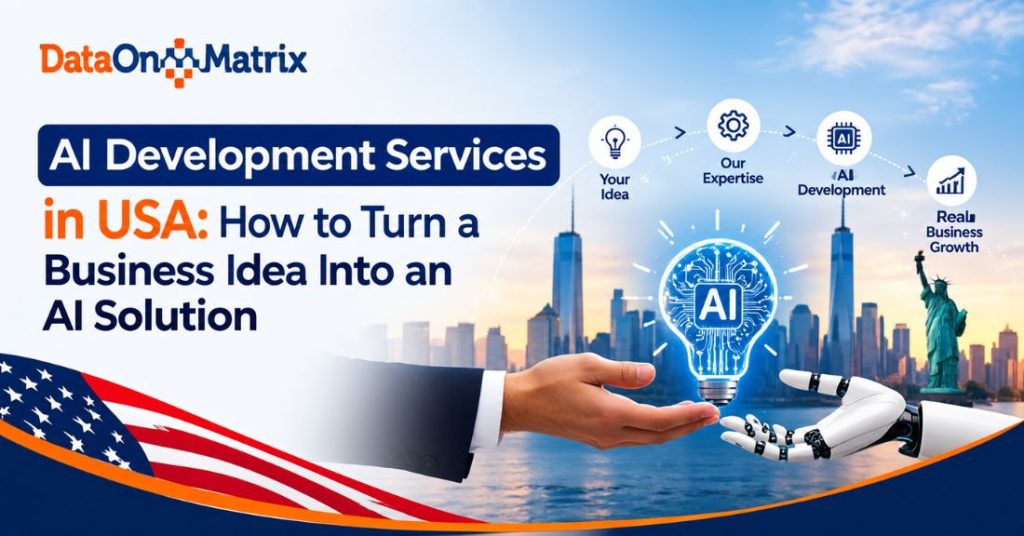
Many businesses have great ideas but do not know where to start. They may see a problem that AI could solve. However, turning that idea into working software takes careful planning. AI development services in USA can help businesses move from an early idea to a useful AI solution.
The process involves;
- Understanding the business problem
- Choosing suitable technology
- Preparing data
- Building software
- Testing results
An excellent AI project should also adapt existing business systems.
For business owners and technology leaders, the main goal is simple. Discover a genuine issue and create a feasible solution. This approach can reduce wasted investment and create better results.
What Are AI Development Services in USA?
AI development services in USA use artificial intelligence to create the appropriate software. These services may include;
- AI strategy
- Software development
- Machine learning
- Generative AI
- Automation
- System integration
An AI project can be very simple. For example, a company may need an assistant that answers common employee questions.
It can also be more advanced. A manufacturer may need AI to predict equipment problems. An online retailer may want a system that recommends products to customers.
The development process usually includes several steps:
- Understanding the business problem
- Defining the project goals
- Reviewing available data
- Selecting suitable AI technology
- Designing the software
- Building and training the system
- Testing the results
- Connecting it with existing systems
- Launching the solution
- Monitoring and improving performance
An existing AI model may solve the problem faster. Developers can connect that model with company data and business software.
This can make the project simpler and more affordable.
How Can Businesses Turn Ideas into Working Solutions?
The development process normally begins after discovering a clear business issue.
Suppose a company receives thousands of customer emails every month. Employees spend hours reading and sorting those emails.
The business idea could be:
“Use AI to organize customer emails.”
The development team can turn that idea into a real solution.
The system could;
- Read incoming emails
- Identify the topic
- Detect customer intent
- Assign priority
- Send messages to the right department
- Suggest responses
The idea has now become a specific software system.
This difference is important. Businesses should not start just considering the technology. They should begin with the problem.
How Do AI Development Services in USA Work?
Turning an idea into an AI solution usually requires a structured process.
1. Start With the Business Problem
The first step is understanding what the company wants to improve.
The problem could involve;
- High operating costs
- Slow customer support
- Manual data entry
- Poor forecasting
- Repetitive employee work
- Complex document processing
- Low sales productivity
The development teams should understand the current process.
This creates a clear starting point.
2. Define the Expected Outcome
The next development phase is to set a measurable objective.
For example:
“Reduce invoice processing time by 50%.”
This is better than saying:
“Use AI for invoices.”
A measurable goal helps everyone understand the project. It also makes later testing easier.
3. Check the Available Data
AI systems often depend on data.
The data may include;
- Customer records
- Sales information
- Business documents
- Product information
- Support conversations
- Images
- Audio
- Website content
- Sensor information
The team needs to check data quality.
Old or incorrect data can affect AI performance.
Privacy must also be considered. Sensitive business information needs suitable protection.
4. Select the Right AI Technology
Different problems require different technologies.
A project might use;
- Machine learning
- Natural language processing
- Generative AI
- Computer vision
- Predictive analytics
- Recommendation systems
- AI agents
- Speech recognition
A simple document classification project may not need a complicated machine learning system.
Choosing the simplest suitable technology can reduce costs.
5. Build a Prototype
A prototype is a small version of the proposed solution.
It helps businesses test the main idea.
For example, an AI chatbot prototype could answer questions from a limited company knowledge base.
The business can then check;
- Accuracy
- Response quality
- Speed
- User experience
- Security
- Integration needs
The development process will continue if the prototype works well.
6. Develop the Full Solution
After testing, developers build the complete system.
This may involve;
- Software development
- AI models
- APIs
- Databases
- User interfaces
The developed solution can also connect with the existing business tools.
7. Test and Deploy
Testing should happen before the system reaches users.
Teams can test accuracy and reliability. They should also test security and performance.
The development team deploys the system after successful testing. Monitoring should continue after launch.
AI systems may need updates as business information changes.
What Are the Key Benefits?
A well-planned AI solution can provide several business benefits.
1. Better Productivity
AI can handle repetitive tasks. Employees can then focus on work that needs human judgment.
For example, AI can summarize long documents. Employees can review the summary instead of reading every page first.
2. Faster Business Processes
AI can rapidly process a large amount of information.
This can reduce delays in areas such as customer service, document review, and data analysis.
Faster processes can also improve customer experiences.
3. Lower Operational Costs
Automation can decrease the volume of manual work.
This does not always mean reducing staff.
Instead, employees can spend more time on valuable tasks.
4. Better Customer Experiences
AI provides more personalized and faster collaborations.
For example, an online store recommends products based on observing customer behavior.
A support assistant can provide answers at any time. It allows human agents to focus on different complex operations.
5. Improved Decision-Making
AI can identify patterns across large datasets.
Business leaders can use these insights when planning.
For example, AI can identify customers’ changing demand patterns. Managers can then review inventory plans.
AI should support decisions rather than blindly make important decisions.
6. Easier Business Scaling
Several manual processes can become hard as a company grows.
AI can automate selected workflows.
This can help businesses manage larger workloads without increasing manual effort at the same rate.
What Are Some Practical AI Use Cases?
An AI development company in USA supports many business functions. The best use cases depend on each company’s needs.
1. AI for Customer Support
Customer support teams often answer similar questions.
An AI assistant can handle common requests. It can search approved company information to provide relevant answers.
Complex issues can move to human agents.
This operation provides a practical combination of human support and artificial intelligence.
2. AI for Sales
Sales teams spend significant time researching leads.
AI can help organize customer information. It can also summarize account activity.
Sales teams can use these insights when preparing conversations.
AI also helps make first drafts for complementary messages.
Human review is an essential part of this process.
3. AI for Finance
Finance departments manage many documents.
These can include;
- Invoices
- Receipts
- Purchase orders
AI can extract information from documents. It can then send structured information into business systems.
This can reduce manual data entry.
4. AI for Human Resources
Employees often ask HR teams similar questions.
An internal AI assistant can answer questions about approved company policies.
Sensitive decisions should still involve qualified human professionals.
5. AI for Healthcare
Healthcare organizations manage large amounts of information. AI helps them with many administrative tasks.
However, healthcare applications require strong privacy and safety controls.
Clinical applications also need appropriate professional oversight.
6. AI for Manufacturing
Manufacturers can use AI to monitor equipment. Sensor data can reveal unusual patterns.
AI can help identify possible maintenance needs.
This may help companies reduce unexpected equipment downtime.
7. AI for E-Commerce
An online store uses Artificial intelligence to enhance product discovery.
Recommendation systems can suggest relevant products.
AI also supports product searches and customer questions.
The goal should be useful recommendations rather than simply showing more products.
What Are AI Business Solutions in USA?
AI business solutions in USA include custom software designed around specific business needs.
These solutions often combine AI with existing business applications.
For example, a company could connect an AI assistant with its CRM.
Another company could connect document AI with its accounting software.
A business might also build an internal knowledge assistant.
The important point is customization.
A generic AI tool may solve part of a problem.
What Challenges Should Businesses Consider?
AI development can create value. It also comes with challenges.
1. Unclear Requirements
Some projects begin with vague goals. This can cause delays.
Business leaders should define the problem before development begins.
2. Data Quality
Poor data can affect AI performance. Companies should review their data before development.
They may need to clean, organize, or label information.
3. Security and Privacy
AI applications can process sensitive information.
Businesses should understand how data is stored and accessed.
Development teams should plan security from the start.
4. Integration Problems
Most custom AI software works with existing business systems.
These may include;
- CRM platforms
- ERP systems
- Databases
- Websites
- Mobile applications
- Internal tools
Poor integration can reduce the value of the AI solution.
5. Employee Adoption
Employees may not immediately trust new technology.
Training can help employees understand the system.
They should know when and how human review is required.
6. Ongoing Maintenance
AI software is not always a one-time project.
Models may need monitoring and updates.
Business data can also change.
Regular reviews help keep the system useful.
When Should a Business Choose Custom AI Software Development Services in USA?
Custom development can make sense when standard tools do not meet business requirements.
For example, a company may have a unique workflow.
Custom AI software development services in USA can provide greater control over features and integrations.
However, custom software is not always necessary. A ready-made AI tool may be enough for a simple requirement.
Businesses should compare both options.
Ask;
- Can an existing tool solve the problem?
- Does the business need unique functionality?
- Are custom integrations required?
- Does the company need control over data?
- Will the solution support future growth?
The answers can guide the decision.
What Should Businesses Do Before Starting Development?
Preparation can make AI projects easier.
Start by documenting the business problem. Then collect basic information about the current process.
Include;
- Current workflow
- People involved
- Time spent
- Existing software
- Available data
- Main problems
- Expected business result
Next, identify a small starting point.
Measure the results. Then decide whether to expand.
This approach reduces risk and creates useful learning.
Conclusion
Transforming a business idea into an AI solution needs more than selecting AI tools.
Companies should define their goals first. They should then review their data and select suitable technology. A small prototype can help test the idea before full development.
The perfect development strategy can improve;
- Productivity
- Reduce manual work
- Support better decisions
- Create better customer experiences
However, businesses should also consider security, data quality, integration, and long-term maintenance.
For companies exploring AI, the practical takeaway is simple:
- Start with the problem
- Build a focused solution
- Measure the results
- Scale what works
This approach can turn promising ideas into useful AI applications that support real business goals.
FAQs
1. What do AI development services in USA include?
They can include AI strategy, software development, machine learning, generative AI, automation, integration, testing, deployment, and maintenance.
2. What is the supposed cost required for AI development projects?
Costs vary based on project complexity, data needs, integrations, and features. A small prototype usually costs less than a full enterprise platform. Businesses should request a detailed project scope before comparing estimates.
3. How long will it take to create an AI solution?
Simple prototypes can take several weeks. Larger business applications may take several months. The timeline depends on requirements, data, integrations, and testing.
4. How can I select the best AI development company in USA?
Review relevant experience, technical skills, security practices, development processes, communication, and support options. Ask for examples of similar projects where possible.
5. Are custom AI solutions better than ready-made tools?
Not always. Ready-made tools can work well for simple needs. Custom solutions may be useful when a business needs unique features, workflows, or integration.