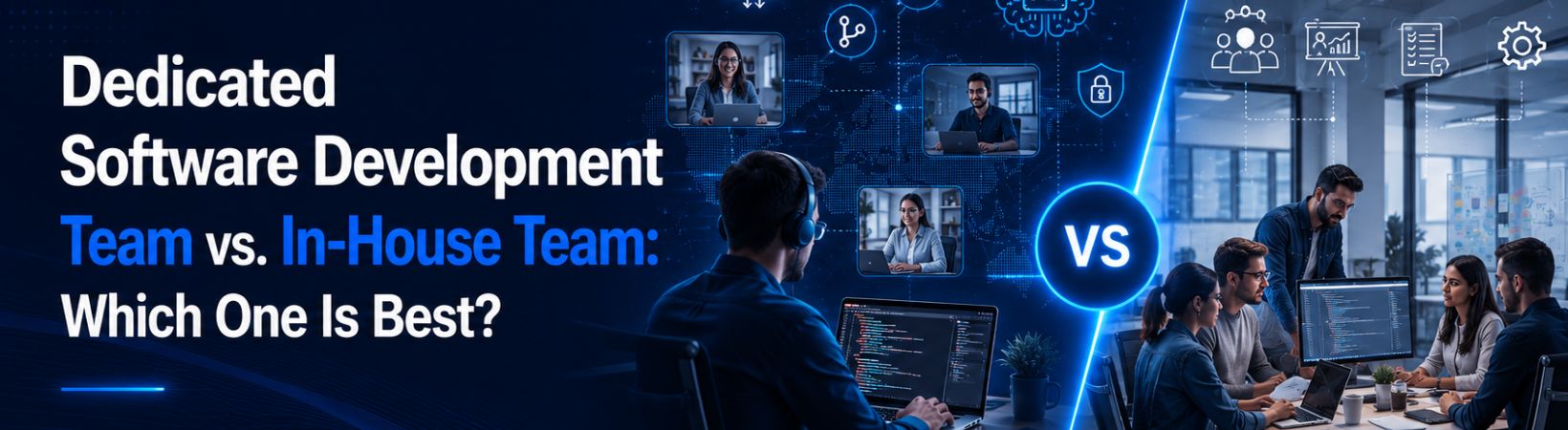

Building a new digital product is an exciting process, but once you have the idea, it needs the correct team to make it work. The first challenge is to determine how you will build it – by your own developers or through an external team. You may already have an idea for what you want to create and the means to begin. The question is, how do you assemble the right team to make it happen? Do you need to find an in-house development team or a dedicated software development team?
Having an in-house team, your developers will become a part of your daily routine. But finding the right people is a time-consuming process. Another way, however, is to have a dedicated software development team that will help you move forward. Have the opportunity to collaborate with seasoned experts and build development capacity without the lengthy hiring process. This decision will depend on the type of product you need, the timeframe, and your current team organization. This article will help you to understand both approaches.
A Snapshot of Both Options:
| If your business needs… | The Better Fit |
| Faster project kickoff
Easy team expansion Access to specialized skills |
Dedicated team |
| Complete internal control
Long-term product ownership Strong internal collaboration |
In-house team |
Let’s look at why.
Two Paths, One Goal:
Now envision two companies with the same concept, the same vision. Both are looking to release a new software product, and both have budgets. The first business is in favor of creating an in-house development team. It works with a software development company experienced in similar projects. The developers and designers have a familiarity with each other’s strengths, allowing them to immediately grasp the planning and construction process of the product.
You’re investing in people who become a part of your company through an in-house team. They get to know your products and your customers, and they are a part of your culture over time. That familiarity can be a blessing in disguise, particularly for any company that continues to grow. Here you are dealing with professionals who are already used to some workflows and have some collaboration. That’s because it saves time in getting everybody on the same page and allows more time to concentrate on the product.
The Hidden Cost of Waiting:
It’s easy to think software development starts when the first line of code is written. In reality, it begins a lot sooner. That’s a more difficult step than many businesses would expect. Finding experienced developers does not happen in a blink. From sourcing candidates to interviewing technical candidates, negotiating salaries, waiting through notice periods, and onboarding new employees, weeks can turn into months. Picture you’re planning a product that has an impenetrable deadline. There are many companies that wish to have a dedicated development team. They don’t do that because it’s not a good idea to have employees. They do it because they need experts who can be available to start contributing nearly right away.
For many businesses, however, building an in-house team is still the best option, particularly if software development is an ongoing component. Recruitment often has far-reaching effects that can be overlooked. There’s more to delays than just slowing development.
The Costs That Rarely Appear in the Budget
They often focus on salaries alone when businesses compare costs. That’s only part of the picture. Building an internal development department usually involves additional expenses. Think about everything that happens behind the scenes.
- Recruitment campaigns
- Technical interviews
- Employee benefits
- Office equipment
- Software licenses
- Training programs
- Performance management
- Staff retention
Two Roads, One Decision:
| Your Own Team | Outsourced Development Team |
| Recruit every specialist separately | Skilled professionals already available |
| Company manages HR responsibilities | Partner manages staffing |
| Internal training required | Experienced team joins immediately |
| Infrastructure managed internally | Infrastructure usually provided |
| Scaling requires new hiring | Team size adjusts as needed |
Beyond a Single Tech Stack:
A customer-facing platform may need cloud architecture. They need security controls and a smooth user experience. A reporting system may depend on engineers who can handle the data workflows.
It can be challenging to find people with all of these skills. Building a team with the right mix of expertise often takes time. The same shift is happening among companies exploring AI development services in the USA. Organizations are looking for engineers who can help them build smarter, from healthcare and finance to retail and manufacturing.
Here’s What Really Happens:
Many people are under the impression that with outsourcing software development, they will lose control of the project. Actually, this will depend much more on the partnership management.
A dedicated development team does not vanish as soon as the coding starts! Regular planning sessions and project documentation keep you involved. They’re made together; priorities can change as the project progresses, and you’ll always know what’s being built. Location is not the determining factor of a successful project. Communication and teamwork can be as open and effective as if it is a few desks away, even when a team is located in another country.
You Need To Ask Before You Decide:
- What is the problem you’re trying to solve?
- Is it slow hiring?
- Not a lot of technical skills?
- A tight deadline?
- Or do you want to create software that will be used for years and years in your business?
Quality Over Quantity:
Sometimes it’s not the size of the team that matters. A project can unexpectedly need:
- A cloud architect with re-architecting infrastructure expertise.
- An IT security expert to bolster data security.
- A UI/UX designer for enhancing its customer experience.
- An AI Engineer is needed to add smart functionalities.
When an In-House Team Is Still the Better Choice
Many businesses will find a dedicated development team to be a great fit. It’s not suitable for all projects. A few companies can benefit from creating their own technical team and growing their knowledge from within over time. Developers are tightly aligned with product managers, sales, and leadership. They grasp the feedback from customers, the priorities of their business, and the internal processes, as they are participating in such conversations on a daily basis. Having an internal team doesn’t exclude the use of external partners. It just depends on knowing what your business requires the most of. It is sometimes more important to have long-term technical ownership than quick speed and flexibility from an external team.
A Story That Sounds Familiar:
A growing logistics company was looking for a better way to manage its day-to-day operations. At first, the plan was straightforward: hire an internal development team and build the software from scratch. It sounded like the safest option, but the reality was more complicated. Weeks passed, and the hiring process was moving slower than expected. Finding developers with the right experience was difficult, salary demands were rising, and the launch date was getting pushed further away.
The company eventually decided it couldn’t wait anymore. It brought in an external development partner to start building the product instead of spending more months assembling a team. In contrast, a small internal team continued to handle business requirements, priorities, and key decisions. The internal team remained involved at every stage, ensuring the software met the company’s needs. When new challenges arose, additional specialists could be brought in.
In the end, the company didn’t just save time. It found a way to combine two important strengths: the technical experience of a ready-to-work development team and the business understanding of its own people.
AI Changes the Equation:
Most software projects were based on web apps and Mobile Apps a few years ago. These days, many companies desire more. They seek software designed to sum up documents and guide people to information in mere seconds. That change has boosted the demand for AI business solutions in nearly every sector.
Developing these skills often necessitates knowledge that traditional development teams may not have. Today, machine learning and model integration are integral components of software development. That’s one of the key factors why more and more companies consider generating AI development services whenever they need to launch their digital products.
Myth vs Reality
Some assumptions continue to influence business decisions—even when experience tells a different story.
| Common Beliefs | Reality |
| External developers won’t understand our business. | Good onboarding and regular communication help dedicated teams learn business processes surprisingly quickly. |
| Hiring employees is always less expensive. | Recruitment, infrastructure, training, and employee retention often increase the total cost of an internal team. |
| Dedicated teams are only suitable for startups. | Large enterprises also use dedicated teams for digital transformation, product expansion, and specialized technology projects. |
| Outsourcing means giving up control. | Clear governance, regular reviews, and shared planning keep businesses actively involved throughout development. |
A Simple Framework for Making the Right Choice
If you’re still weighing your options, don’t start with pricing. Start with these questions.
- How quickly does the project need to begin?
- Will the software require long-term internal ownership?
- Do you already have experienced technical leadership?
- Are specialized skills needed only for a limited period?
- Could project requirements change significantly over the next year?
An Expert Observation
The biggest challenges usually don’t come from choosing the wrong development model. The real problem often starts when the approach doesn’t fit the company’s goals, timeline, or the way the business operates.
A company trying to launch a new product quickly will face a completely different set of challenges than a business managing and improving a large, established platform. The right choice depends on understanding those differences early before hiring decisions are made, resources are committed, and valuable time is lost.
Technology partners like DataOnMatrix help organizations build software with this long-term perspective, combining experienced engineering talent with practical business thinking to create solutions that continue delivering value long after launch.
Common FAQs:
-
Can a dedicated development team work with our existing in-house developers?
Yes, and in many cases, this combination works extremely well. A dedicated development team can work alongside your internal employees. Your team stays focused on business priorities while the dedicated experts help you move faster and build better solutions.
-
How quickly can we start working with a dedicated development team?
The process is usually much faster. You can quickly connect with experienced professionals who are ready to understand your project and start contributing right away.
-
How do dedicated teams protect our confidential information?
Professional development partners take security seriously. They use agreements such as NDAs, secure tools and environments, access controls, and proven security practices to protect your business information.